Gamma Knife Radiosurgery in Turkey
FREE PRE-EVALUATION
Upload your MRI reports to request analysis from a specialist.
Consultant Status: Online
Gamma Knife Radiosurgery in Turkey
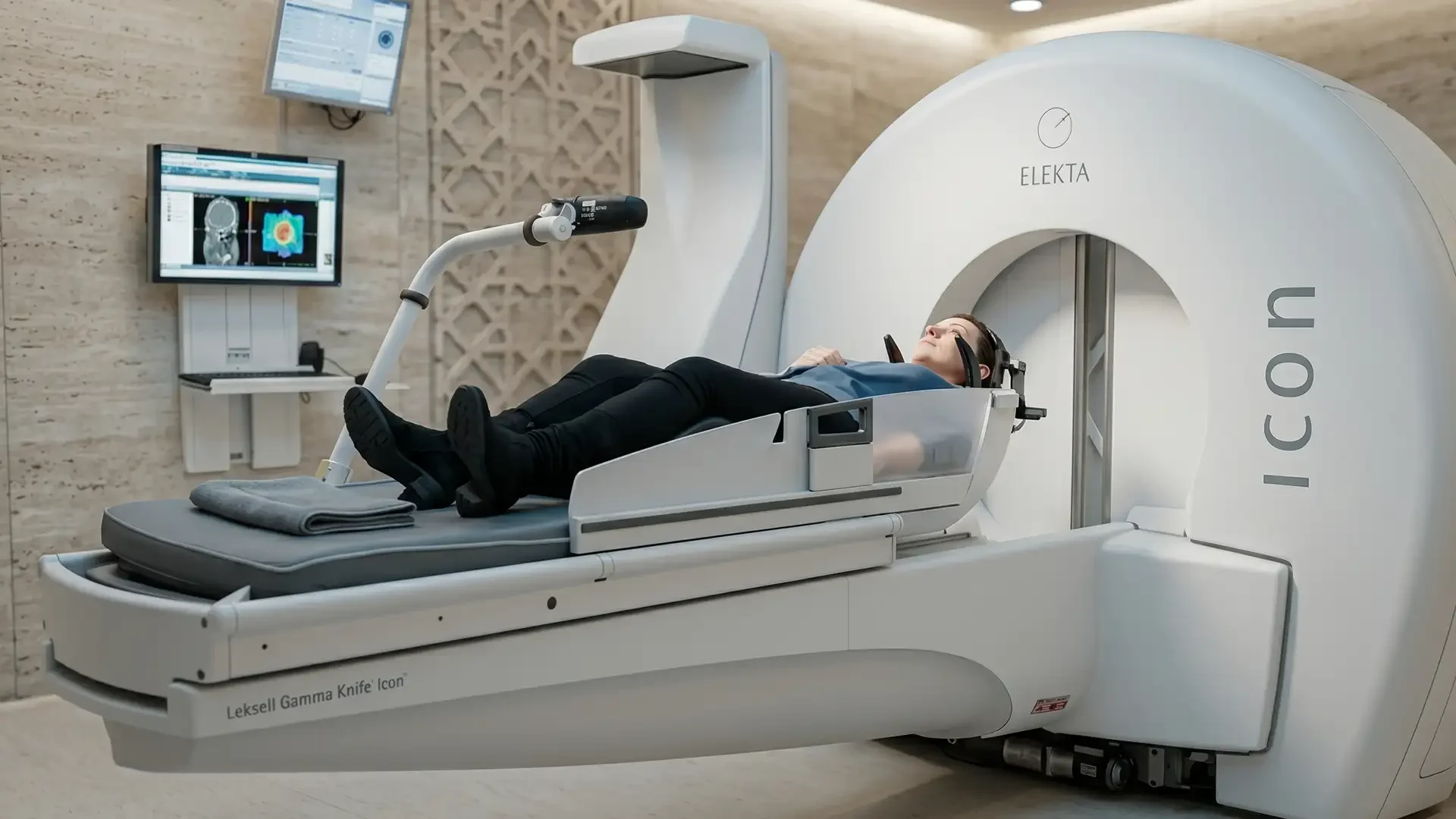
Unlike conventional radiotherapy, which exposes a broad field of the brain to radiation over many sessions, Gamma Knife treats the precise target in a single outpatient appointment with no incision, no general anaesthetic, and no hospital admission. Patients arrive in the morning and return to their hotel the same evening. When comparing the recovery timelines of Gamma Knife vs. open brain surgery, this outpatient model makes it one of the most patient-friendly procedures in all of neurosurgery.
Gamma Knife stands apart from other radiotherapy devices due to its incredible pinpoint accuracy in focusing radiation, which is exactly why its name references a surgical knife. The system utilizes hundreds of individual gamma beams aimed at a single point. Because these individual beams are low-dosage, they pass safely through the brain without harming healthy surrounding tissue. However, where all the beams converge on the target area, they deliver a powerful, concentrated dose. This ensures the radiation affects only the specific area meant to be treated, minimizing side effects and protecting healthy brain function.
Turkey's Gamma Knife centre is led by Prof. Dr. Türker Kılıç, the pioneer who introduced the technology to the country and has since treated more than 30,000 patients. International patients choose Istanbul for access to this level of expertise at a cost 60 to 70 per cent below UK and German prices.
Conditions This Treatment Addresses
Frequently Asked Questions
About Gamma Knife Radiosurgery in Turkey
What is Gamma Knife radiosurgery?
Gamma Knife is a non-invasive brain treatment that uses 192 focused radiation beams to target brain lesions with sub-millimetre accuracy. Despite the name, there is no incision or cutting — the converging beams deliver radiation precisely to the target while sparing healthy surrounding tissue.
Is Gamma Knife painful?
The procedure itself is painless — patients feel nothing during radiation delivery. The only discomfort is from the application and removal of the stereotactic frame (local anaesthetic is used for the pin sites), which causes mild pressure. Most patients describe the overall experience as far easier than they expected.
How long does Gamma Knife treatment take?
The entire process — frame application, imaging, planning, and radiation delivery — typically takes one day. The actual radiation delivery ranges from 15 minutes to 2 hours depending on the size and number of targets. Most patients go home the same day.
How effective is Gamma Knife for brain tumours?
Tumour control rates (stopping growth or shrinking) for common indications range from 85–98%, depending on tumour type and size. Meningiomas, acoustic neuromas, and brain metastases respond particularly well. Results are comparable to open surgery for appropriately selected cases, with significantly lower complication rates.
How much does Gamma Knife cost in Turkey?
Gamma Knife treatment in Turkey costs approximately £5,000–£10,000, compared to £15,000–£25,000 in the UK. The procedure is also covered under Turkey's SGK social security system, which may further reduce costs.
Can Gamma Knife treat multiple brain tumours?
Yes. Multiple targets can be treated in a single session — this is one of Gamma Knife's key advantages over open surgery, which would require separate craniotomies for each tumour location. This makes it particularly valuable for brain metastases, where multiple lesions are common.
What is the recovery time after Gamma Knife?
Most patients return to normal activities within 1–2 days. There is no surgical wound, no general anaesthesia, and no extended hospital stay. Some patients experience mild headache or fatigue for 24–48 hours.
Who should not have Gamma Knife?
Gamma Knife is not appropriate for very large tumours (typically >3cm diameter), where the radiation dose needed would affect too much surrounding tissue. It is also not suitable for tumours causing acute mass effect (dangerous pressure on the brain) that requires urgent surgical decompression. Prof. Kılıç evaluates each case individually and recommends open surgery when it is the safer option.
The Gamma Knife Procedure: What to Expect
Gamma Knife is typically a single-day procedure. Most patients arrive in the morning and go home the same day or the following morning.
Step 1: Admission, Preperation and Frame Application (90 minutes)
A lightweight stereotactic frame is attached to the patient's head under local anaesthesia. This frame provides the coordinate reference system for targeting. Frameless alternatives (using a thermoplastic mask) are available for certain indications and fractionated treatments.
Step 2: Imaging (1 hour)
High-resolution MRI (and sometimes CT or angiography) is performed with the frame in place. These images are used to map the exact location, size, and shape of the target lesion in three dimensions.
Step 3: Treatment Planning (1 hours)
The neurosurgeon and medical physicist use specialised software to design the radiation plan, determining how many "shots" (individual beam configurations) are needed, their position, and the dose distribution. This is the most intellectually demanding phase: the plan must deliver a therapeutic dose to the entire target while respecting dose limits on surrounding structures (optic nerves, brainstem, cochlea).
The patient rests comfortably during this phase.
Step 4: Radiation Delivery (30 minutes–2 hours)
The patient lies on the treatment couch and the head frame is locked into the Gamma Knife unit. The machine delivers radiation in complete silence with no sensation. Treatment duration depends on the size and complexity of the target, a small acoustic neuroma might take 20 minutes; multiple brain metastases might take 1–2 hours.
Step 5: Frame Removal & Discharge (2 hours)
The frame is removed (a simple process), the pin sites are cleaned, and the patient is observed briefly before discharge. No surgical wound exists. Most patients experience mild headache or fatigue, which resolves within 24–48 hours.
Your Surgeon: Prof. Dr. Türker Kılıç
Vellum Select's curated Gamma Knife specialist is Prof. Dr. Türker Kılıç, the neurosurgeon who was the first to perform Gamma Knife radiosurgery in Turkey.
Prof. Kılıç trained at Hacettepe University and Harvard University and has treated over 30,000 patients across his career using microsurgery and Gamma Knife. He holds an H-index of 40 (placing him in the top tier of neurosurgical researchers globally) and has published over 200 scientific papers with more than 6,000 citations. He is the only scientist in Turkey elected to both the European Academy of Sciences and Arts and the World Academy of Art and Science.
His programme at BAU Medical Park Göztepe Hospital operates the Gamma Knife Icon system, the latest generation of Gamma Knife technology, which supports both frame-based and frameless treatments.
View Prof. Dr. Kılıç's full profile →
What Conditions Does Gamma Knife Treat?
Brain Tumours
Gamma Knife is used to treat both benign and malignant brain tumours, including meningiomas (the most common benign brain tumour), acoustic neuromas (vestibular schwannomas), brain metastases from cancers that have spread to the brain, and recurrent gliomas where further open surgery carries unacceptable risk. For small to medium-sized tumours, Gamma Knife can achieve tumour control rates comparable to open surgery without the risks of craniotomy.
Read more about Brain Tumour Surgery in Turkey →
Pituitary Tumours
Pituitary adenomas (tumours of the pituitary gland that can cause hormonal imbalances (Cushing's disease, acromegaly, prolactinoma)) are a significant portion of the Gamma Knife caseload. Radiosurgery is used as a primary treatment for small adenomas, as an adjunct after incomplete surgical resection, or for patients who are not surgical candidates.
Read more about Pituitary Tumour Treatment in Turkey →
Arteriovenous Malformations (AVMs)
AVMs are abnormal tangles of blood vessels in the brain that carry a risk of haemorrhage (bleeding). Gamma Knife causes the AVM to gradually close over 1–3 years by thickening the walls of the abnormal vessels. It is particularly effective for small to medium-sized AVMs in deep or eloquent brain areas where open surgery would be too risky.
Trigeminal Neuralgia
Trigeminal neuralgia causes severe, electric shock-like facial pain that is often described as the worst pain known in medicine. When medication fails, Gamma Knife can target the trigeminal nerve root with a focused radiation dose, providing pain relief in 70–90% of patients without the risks of open microvascular decompression surgery.
Other Indications
Gamma Knife is also used for select cases of epilepsy, select cranial nerve disorders (e.g., hemifacial spasm), and certain functional brain conditions. Each case is evaluated individually.
Gamma Knife Cost in Turkey vs. the UK and Europe
| Country | Gamma Knife Cost (approximate) |
|---|---|
| United Kingdom | £15,000–£25,000 |
| Germany | €15,000–€30,000 |
| United States | $20,000–$50,000 |
| Turkey (Istanbul) | £5,000–£10,000 |
Gamma Knife is covered under Turkey's SGK (Social Security Institution), which can further reduce costs for eligible patients. Pricing includes pre-treatment MRI and planning, the radiosurgery procedure, and post-treatment follow-up imaging.
Gamma Knife and open surgery are not competitors; they are complementary. Prof. Kılıç's dual expertise in both microsurgery and Gamma Knife means treatment recommendations are guided by what is best for each individual patient, not by the limitations of a single technique.
Journey to Recovery
Day 1, Morning: Arrival and Frame Application
International patients arrive at BAU Medical Park Göztepe Hospital in the morning. A lightweight stereotactic frame is attached to the head under local anaesthesia, providing the precise coordinate reference system for targeting. Frameless alternatives using a thermoplastic mask are available for certain indications.
Day 1, Morning: Arrival and Frame Application
International patients arrive at BAU Medical Park Göztepe Hospital in the morning. A lightweight stereotactic frame is attached to the head under local anaesthesia, providing the precise coordinate reference system for targeting. Frameless alternatives using a thermoplastic mask are available for certain indications.
Day 1, Late Morning: High-Resolution Imaging
High-resolution MRI (and sometimes CT or angiography) is performed with the frame in place. These images map the exact location, size, and shape of the target lesion in three dimensions. The imaging session typically takes one hour.
Day 1, Late Morning: High-Resolution Imaging
High-resolution MRI (and sometimes CT or angiography) is performed with the frame in place. These images map the exact location, size, and shape of the target lesion in three dimensions. The imaging session typically takes one hour.
Day 1, Before Noon: Treatment Planning
Prof. Dr. Kılıç and the medical physics team use specialised software to design the radiation plan, determining the number of shots, their positions, and dose distribution. This phase takes 1 to 2 hours. Patients rest comfortably in a private room while the plan is prepared.
Day 1, Before Noon: Treatment Planning
Prof. Dr. Kılıç and the medical physics team use specialised software to design the radiation plan, determining the number of shots, their positions, and dose distribution. This phase takes 1 to 2 hours. Patients rest comfortably in a private room while the plan is prepared.
Day 1, Midday: Gamma Knife Radiation Delivery
The patient lies on the treatment couch and the head frame is locked into the Gamma Knife Icon unit. Radiation is delivered in complete silence with no sensation. Treatment duration is 15 minutes to 2 hours depending on the complexity and number of targets.
Day 1, Midday: Gamma Knife Radiation Delivery
The patient lies on the treatment couch and the head frame is locked into the Gamma Knife Icon unit. Radiation is delivered in complete silence with no sensation. Treatment duration is 15 minutes to 2 hours depending on the complexity and number of targets.
Day 1, Afternoon: Frame Removal and Discharge
The frame is removed, pin sites are cleaned, and the patient is observed briefly before discharge. Most patients experience only mild headache or fatigue. International patients typically return to their hotel the same evening and are free to fly home within 24 to 48 hours.
Day 1, Afternoon: Frame Removal and Discharge
The frame is removed, pin sites are cleaned, and the patient is observed briefly before discharge. Most patients experience only mild headache or fatigue. International patients typically return to their hotel the same evening and are free to fly home within 24 to 48 hours.
Days 1, Evening: Rest and Recovery
Most patients feel well enough to explore Istanbul or prepare for their return journey. Mild fatigue is normal and no wound care is required. A follow-up MRI is typically scheduled for 3 to 6 months post-treatment, which can be arranged locally or at home.
Days 1, Evening: Rest and Recovery
Most patients feel well enough to explore Istanbul or prepare for their return journey. Mild fatigue is normal and no wound care is required. A follow-up MRI is typically scheduled for 3 to 6 months post-treatment, which can be arranged locally or at home.