
Look beyond the social-media label. A practical consultation checklist covering treatment options, tooth preparation, dental-team credentials and aftercare.
“Turkey teeth” is a social-media label, not a dental diagnosis or a defined treatment. It can obscure the question that matters most: what exactly is being proposed for your own teeth?
A quote might involve veneers, crowns or several different treatments. The country, package name and promised appearance do not explain why a procedure is appropriate. Before agreeing to irreversible dental work, ask for the diagnosis, the proposed treatment for each tooth, the alternatives and the aftercare arrangements in writing.
This guide is a consultation checklist, not a recommendation for a particular procedure. It complements our existing veneers guide by focusing on how to understand a proposal and ask better questions before you commit.
1. Start with the treatment, not the label
If an advertisement uses “Turkey teeth,” “Hollywood smile” or “smile makeover,” ask the provider to translate that description into a treatment plan. What will be done, to which teeth, by whom, and for what reason?
A package description is useful for understanding what a seller offers. It is not a substitute for an individual assessment. The General Dental Council advises patients considering treatment abroad to be assessed by a qualified dentist before receiving a treatment plan and cost estimate. It also recommends discussing plans with your own dentist. [3]
A practical opening question is: “What is my diagnosis, and how does each proposed treatment address it?”
2. Understand whether you are discussing veneers or crowns
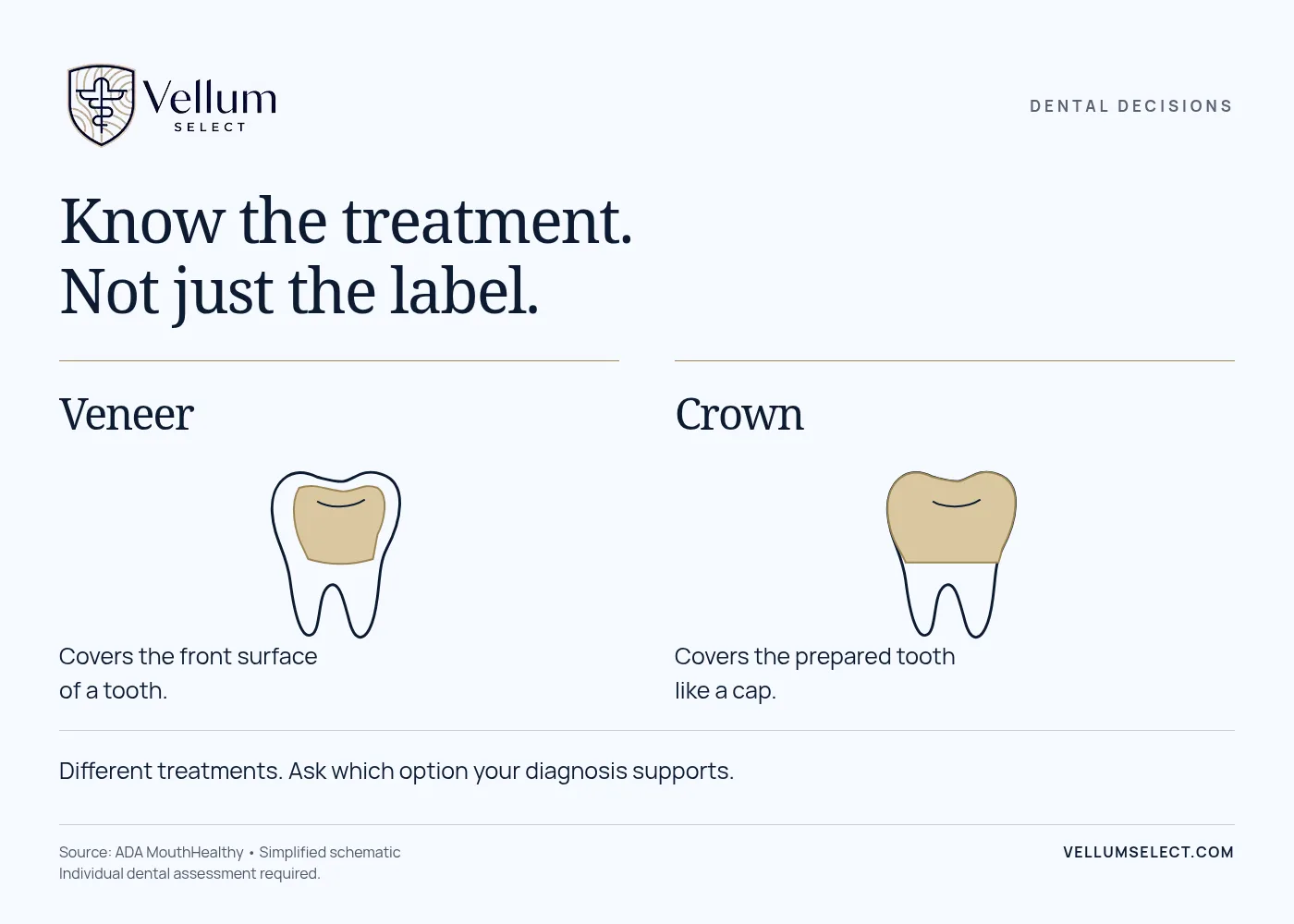
Veneers and crowns are different restorations. The American Dental Association describes veneers as coverings for the front surface of a tooth, while crowns cover a tooth to restore its shape and size. Crowns can be appropriate for a range of restorative needs, including supporting a tooth with substantial structural loss. [1, 2]
Neither name, by itself, tells you whether treatment is appropriate for you. Ask the dentist to explain the proposed choice for each tooth. Avoid assuming that every tooth needs the same restoration simply because that is how a package is priced.
Questions to take to your consultation:
- Is each proposed restoration a veneer or a crown?
- What problem does it address on that tooth?
- Which teeth, if any, do not need treatment?
3. Ask about tooth preparation before agreeing
Preparation is not a detail to leave until the day of treatment. Ask what changes will be made to your natural teeth, how much tooth structure is expected to be removed, and why.
The ADA explains that veneer treatment can involve removing enamel and is not reversible. It also notes that existing dental problems should be addressed before veneers are placed. [1] Descriptions such as “minimal preparation” should therefore lead to a specific discussion about your own proposed treatment, not an assumption that no permanent changes are involved.
Ask for an explanation you can understand. If a term remains unclear, request another explanation before signing consent or paying for treatment.
4. Discuss the alternatives, including not proceeding
Ask your dentist which other approaches are reasonable in your circumstances. Depending on the diagnosis, the discussion may include a different restorative plan, treating existing dental disease first, or deciding not to proceed with cosmetic treatment.
This is not a list from which to choose your own procedure. It is a prompt for a clinician-led comparison. Ask what each option aims to achieve, what it cannot achieve, its disadvantages, and what future care it may involve.
A useful question is: “If these were your treatment options rather than a package selection, how would you explain the trade-offs?”
5. Know who will actually treat you
A clinic name, coordinator or attractive website is not the same as knowing the treating clinician. Request the full name of the dentist responsible for your assessment and the dentist who will carry out the work, if different.
Check professional registration using the relevant regulator or professional authority for the country of treatment. The GDC highlights that regulatory arrangements differ between countries and encourages patients to ask about qualifications and registration. Its UK register concerns professionals practising in the UK; it is not a worldwide clinic approval system. [3]
If someone describes themselves as a specialist, ask what that qualification means and how it can be independently checked.
6. Get a written, itemised proposal
Before comparing headline prices, make sure the proposals describe comparable work. Ask for a written plan that identifies the proposed procedures, relevant teeth, materials, appointment arrangements and costs.
Separate the dental treatment from travel and accommodation. If a package includes transfers, a hotel or an interpreter, ask for those inclusions to be stated explicitly. Do not assume they are included because they appeared in a general advertisement.
Keep a copy of the version you agreed to. If the plan changes after an examination, ask what changed, why, and how that affects your options and costs before deciding whether to proceed.
7. Make consent a conversation
A signature should follow an explanation, not replace one. Ask about the purpose of the proposed work, the important risks, the alternatives and what to expect if you choose not to proceed.
You should be able to describe the plan back in your own words. If you cannot, pause and ask more questions. Language support can help, but establish who provides it and whether it covers the clinical explanation rather than only travel coordination.
The GDC specifically encourages patients to ask questions and not feel obliged to commit when answers are unsatisfactory. [3] A flight, discount or booking deadline should not be the reason you accept a plan you do not understand.
8. Decide what you need from records and documentation
Ask what records you can receive and in what format. Discuss copies of the agreed treatment plan, consent information, relevant examination records, and a summary of the work completed.
If a different dentist provides follow-up, useful documentation can make that conversation more informed. Ask your treating clinician which records are relevant to your case and arrange access before you travel home.
Keep contact details, invoices and any written aftercare or guarantee terms with those records. A practical document folder is more useful than relying on scattered messages or a coordinator's verbal summary.
9. Plan aftercare before booking travel
Ask who is responsible for follow-up during your stay and after you return home. Establish the clinical contact, how to reach them, and how urgent concerns are handled.
The GDC recommends asking about aftercare, what happens if you are unhappy with the result, and who pays for additional travel, accommodation or remedial work. [3] Those are separate questions: a provider offering to assess a concern does not necessarily mean every associated cost is covered.
Avoid relying on the word “guarantee” without reading the terms. Ask what is included, what is excluded and what steps you must follow if a problem occurs.
10. Leave room for an individual timetable
Ask your dentist how the assessment, treatment and follow-up fit together for your particular plan. Clarify what needs to be completed before you leave, which decisions remain provisional, and whether further visits may be necessary.
Do not use another patient's itinerary as your own clinical timetable. Travel arrangements should leave space for the treating dentist's assessment rather than force treatment into a schedule already booked.
This guide does not give a universal treatment duration or flight-clearance rule. If timing affects your decision, ask your clinician, airline and insurer the relevant questions before purchasing non-refundable travel.
11. Use reviews and photographs as starting points
Reviews and photographs may help you decide what to investigate, but they cannot provide a diagnosis for your teeth or establish that the same treatment is appropriate for you.
Ask what the examples show: the procedures performed, how the case differed from yours, and whether follow-up information is available. Do not equate a particular shade, uniform appearance or dramatic transformation with the right clinical choice.
Your own assessment, explanation of options and written plan remain the basis for deciding whether to proceed. An individual plan should make sense even without a social-media endorsement.
12. A checklist to save before you commit
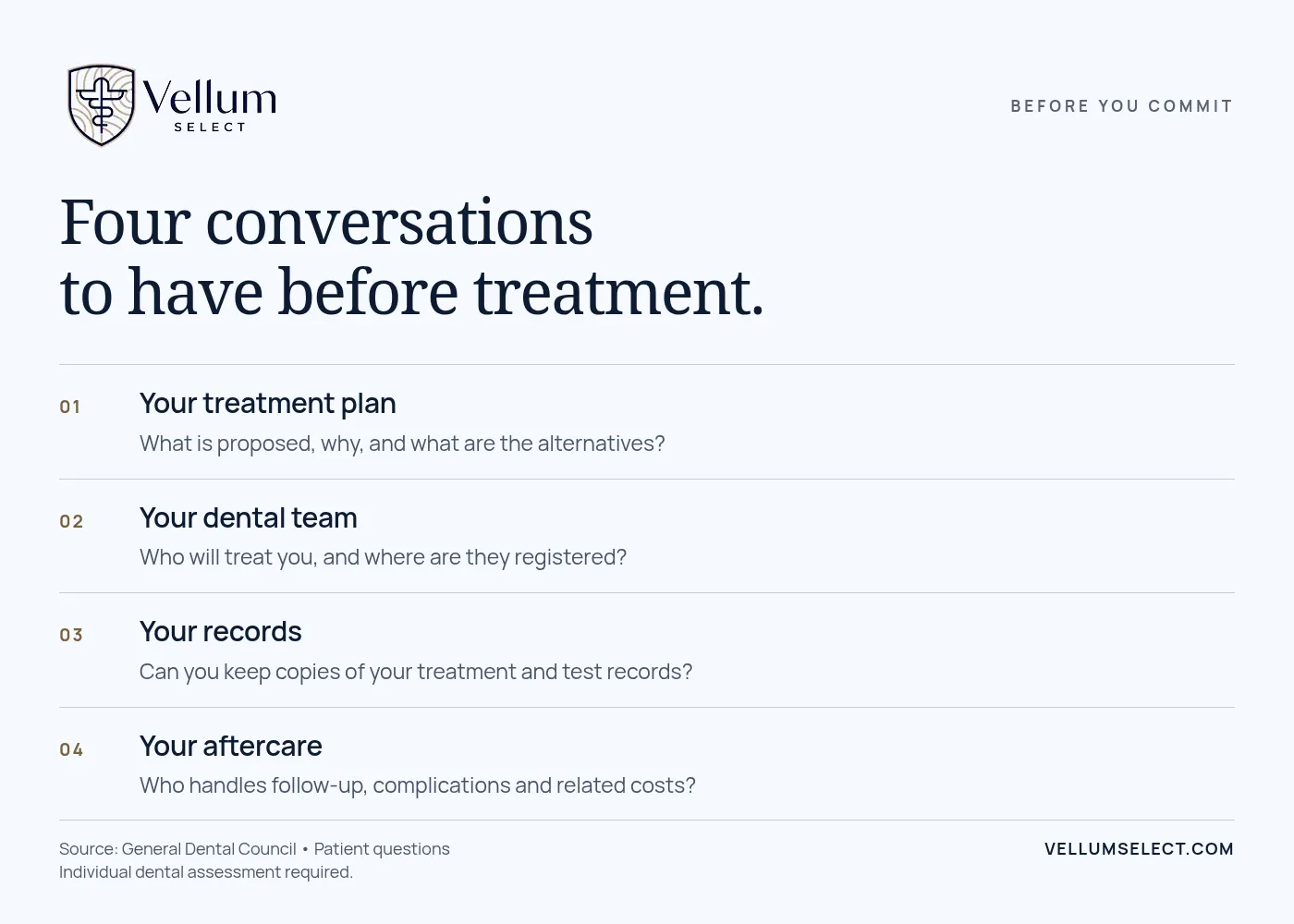
Before agreeing to dental treatment abroad, make sure you can answer these questions:
- What is my diagnosis, and which teeth require treatment?
- Are veneers, crowns or other procedures proposed, and why?
- What tooth preparation is expected, and what are the alternatives?
- Who will assess and treat me, and how can I check their registration?
- What exactly is included in the written proposal and price?
- Have the risks, limitations and consent information been explained?
- Which treatment records will I receive?
- Who provides aftercare, and who pays if further care is needed?
If an important answer is missing, treat that as an unresolved decision—not as a detail to sort out after treatment.
Frequently asked questions
Does “Turkey teeth” mean veneers?
No. The phrase does not reliably identify a procedure. Ask whether the actual proposal involves veneers, crowns or other dental work. Veneers and crowns are distinct restorations. [1, 2]
Are crowns always the wrong option?
No. Crowns have established restorative uses. The relevant question is whether the diagnosis and condition of a particular tooth support the proposed treatment. That assessment belongs with your dentist. [2]
Can photographs alone tell me which procedure I need?
Do not treat photographs or a package quote as a substitute for an individual clinical assessment. The GDC advises assessment by a qualified dentist before a treatment plan and cost estimate. [3]
Should I speak to my dentist at home first?
The GDC recommends doing so before considering treatment abroad, particularly because your dentist knows your dental history and should be aware of your plans if later concerns arise. [3]
A considered next step
Before making travel arrangements, organise your questions and request a clear explanation of the proposed care. If you want to discuss a Vellum Select enquiry, contact the team with the treatment you are considering and the questions you need answered. Do not send sensitive health records through public social-media comments.
Educational disclaimer: This article provides general information and does not diagnose a condition, recommend a treatment for an individual, or replace advice from a qualified dentist. Clinical suitability, risks and follow-up requirements must be assessed for your own circumstances.
Sources
[1] American Dental Association, MouthHealthy — Veneers: https://www.mouthhealthy.org/all-topics-a-z/veneers
[2] American Dental Association, MouthHealthy — Crowns: https://www.mouthhealthy.org/all-topics-a-z/crowns
[3] General Dental Council — Going abroad for dental treatment: https://www.gdc-uk.org/standards-guidance/information-for-patients-public/going-abroad-for-dental-treatment
Safety and Patient Rights