
A sinus lift is not an automatic implant step. Understand the upper-back-jaw assessment, alternatives, risks and follow-up questions to discuss with a clinician.
A sinus lift is not an automatic step before dental implants. It is one possible way to create bone support beneath the sinus when implants are planned in the upper back jaw. Other approaches may be available, including a different implant plan or a bridge or denture.[1] The useful question is not whether everyone with missing molars needs grafting, but why a particular clinician recommends it for a particular restoration.
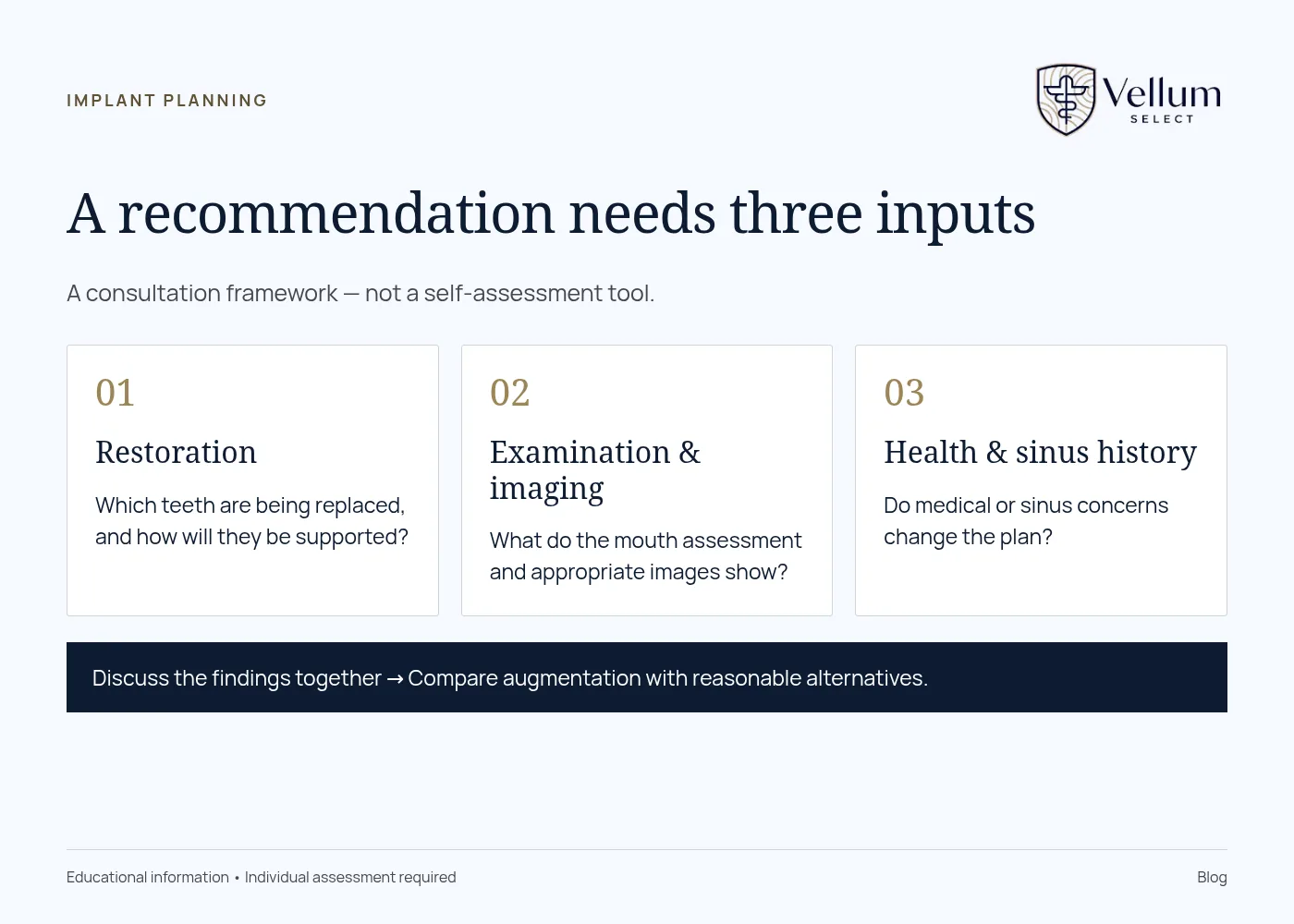
If you are researching sinus lift turkey, use this guide to prepare for that discussion, not to decide your own candidacy. Ask for an explanation that connects the examination, imaging, sinus history and proposed replacement teeth. A recommendation should make sense as a whole treatment plan, not simply as an extra item on a quotation.
1. What a sinus lift actually changes
The maxillary sinuses are air-filled spaces above the upper premolars and molars. A sinus lift raises the thin lining above the jaw to create space underneath it; bone-grafting material can be placed in that space to support future implants.[1] It is not a procedure for straightening the nose or a general treatment for blocked sinuses.
After tooth loss, the remaining upper-jaw bone and the position of the sinus can limit where implants fit. An implant needs a suitable position for the planned teeth, not just somewhere a screw will fit.[2][3] This is why the assessment should start with the proposed crown, bridge or denture and work back to the support it needs.
Vellum Select’s bone grafting and sinus lift page provides service context.[4] This article is a consultation companion: it focuses on questions, alternatives and continuity of care rather than treating a service description as proof that you need surgery.
2. What the clinician needs to assess
Implant assessment includes the health of the mouth and the available bone, alongside general health and the ability to maintain the restoration. Active dental infection and oral hygiene matter; suitability is an individual decision.[9] Being able to name the procedure is therefore not the same as having a complete diagnosis or treatment plan.
Imaging helps the clinician assess the proposed sites. Dental X-rays may be used initially, and three-dimensional imaging may be indicated to understand the anatomy more fully.[9] Cone-beam CT can help assess bone volume and support planning of the implant position.[3] Ask what the images show, why a particular scan is needed and whether existing images are adequate. Do not try to interpret a screenshot or a single measurement yourself.
A useful consultation explanation should cover:
- Which missing teeth the restoration will replace, and why those implant positions are proposed.
- What the imaging adds to the examination, rather than merely confirming that a scan was taken.
- Which part of the plan requires additional bone support and which alternatives were considered.
- What would change the recommendation before treatment or during surgery.
Bring a current medicine list and disclose health conditions, allergies, previous procedures and smoking. Medical conditions and medicines can change the advice given for bone grafting, and smoking can impair wound healing.[8] Do not stop prescribed medicines or change doses to prepare for a consultation; ask the treating team to coordinate any necessary instructions with the prescriber.
3. Why your sinus history belongs in a dental consultation
Tell the clinician about recurring sinus infections, ongoing nasal obstruction, previous sinus surgery and symptoms affecting the same side as the proposed implants. A small retrospective case series of patients referred with complications highlights the relevance of pre-existing sinus disease and obstructive anatomy when planning sinus augmentation.[2] It does not establish that every patient needs an ENT assessment or predict an individual complication rate.
The clinician may recommend further evaluation or discussion with an ear, nose and throat specialist if the history or imaging raises concerns.[2] Ask who will make that decision and whether additional assessment should happen before an operative date is agreed.
A scan finding is not a self-diagnosis. Equally, persistent sinus symptoms should not be left out because the appointment is called “dental.” Bring previous reports if available, describe the symptoms in plain language and ask for the dental and sinus findings to be considered together.
4. When no sinus graft may be discussed
A sinus lift is elective, and declining it should lead to a discussion of other ways to manage the missing teeth. The alternatives described in NHS guidance include shorter implants, different implant positions, bridges, dentures and sometimes no tooth replacement.[1] None is automatically the right choice.
A different implant design or position. A clinician may discuss shorter implants or a plan that uses suitable bone farther forward or beside the sinus.[1] Ask how the proposed teeth would be supported, what compromises the design involves and how cleaning and maintenance would work. “Graft-free” describes a treatment approach, not a promise of lower risk or a better result.
A tooth-supported bridge. This may avoid implant surgery, but the condition of the adjacent teeth and the bite affect whether it is appropriate.[1] Ask what preparation those teeth would need and how the bridge would be maintained.
A removable denture or accepting a gap. These are also legitimate subjects for discussion, depending on function and the wider dental situation.[1] A comparison should include comfort, upkeep and your preferences, not only whether a restoration is fixed.
A helpful way to compare proposals is to ask each clinician to explain the same endpoints: the teeth being replaced, expected maintenance, surgical burden, uncertainties and fallback options. Avoid assuming that the most extensive operation is the most thorough care, or that avoiding a graft removes all treatment risk.
5. If augmentation is recommended, ask which approach and why
The two broad routes are an external approach through the side of the upper-jaw bone and an internal approach through the implant preparation site. The remaining bone and planned procedure influence the choice; implants may be placed during augmentation or in a later operation.[1]
Ask the surgeon to describe the selected route without relying on a marketing label. “Minimally invasive” is not a substitute for explaining what will happen, which risks apply and why that route fits the anatomy. A 2026 expert survey on complex upper-jaw rehabilitation documents variation in practice and areas needing further research; it is not a universal recipe for every missing upper tooth.[3]
Also ask what graft material and protective membrane are proposed, where they come from and why they were selected. Human-derived, animal-derived, synthetic and the patient’s own bone are among the materials used in grafting.[1][8] Raise religious, ethical or personal concerns before consent, while there is time to discuss options.
6. Timing is a sequence of reviews, not a guaranteed date
A sinus lift, implant placement and attachment of the final teeth are different treatment steps. They may not happen together. The surgical and restorative phases depend on the plan and healing, and additional grafting can extend treatment.[1][9]
Ask for a provisional sequence rather than a promise that you will be ready on a particular date. Which review checks the graft? What determines readiness for implants if they are placed later? What confirms readiness for the final restoration? The written plan should distinguish a temporary tooth replacement from the final teeth.
Vellum Select’s dental implants page is a second starting point for the wider treatment discussion.[5] Confirm your own proposed stages directly with the treating clinician. Do not translate a general website timeline into a personal booking schedule.
For treatment abroad, ask what happens if a review changes the sequence. Request a written breakdown covering assessment, graft materials, surgery, temporary teeth, subsequent restoration and follow-up. Clarify which costs are included and which would arise if a visit or procedure had to be rescheduled. Leave travel decisions open until the treating team has explained the plan and relevant restrictions.
7. Risks deserve more than a success-rate headline
The sinus lining can tear during surgery. Depending on the situation, the surgeon may repair it or stop and allow healing before another attempt.[1] Ask how a membrane problem would change the plan, including whether implant placement would be deferred.
Other possible problems include bleeding, swelling, pain, infection, graft exposure, inadequate bone formation and, rarely, a communication between the mouth and sinus or infection requiring graft removal.[1][8] The purpose of discussing these risks is informed consent, not to suggest that complications are inevitable.
Sinusitis is another possible complication. Some affected patients need coordinated dental and ENT care.[2] Ask who manages this if you have returned home and whether the surgeon can share records promptly with a local clinician. Do not treat a complication rate from a small referred case series as your own probability of harm.
The consent discussion should explain your own risk factors, reasonable alternatives and the response if treatment cannot proceed as planned. You should have time to ask questions before agreeing, rather than meeting these issues for the first time on the day of surgery.[8]
8. Arrange dental and sinus follow-up before travelling
Get written postoperative instructions specific to the procedure, including mouth care, nose blowing, sneezing, activity, medicines and how to contact the surgeon. Sinus-lift guidance includes restrictions on nose blowing and review during healing.[1] Do not borrow another patient’s medication regimen or start nasal treatments independently; follow the instructions issued for your case and ask about anything unclear.
Contact the treating team promptly for worsening pain or swelling, persistent or continuous bleeding, fever, feeling generally unwell or suspected displacement of graft material.[1] Do not wait for the next planned flight or routine review to report concerns. If sinus symptoms worsen or you feel very unwell, obtain urgent local medical advice; general NHS sinusitis guidance also identifies these as reasons for urgent assessment.[10]
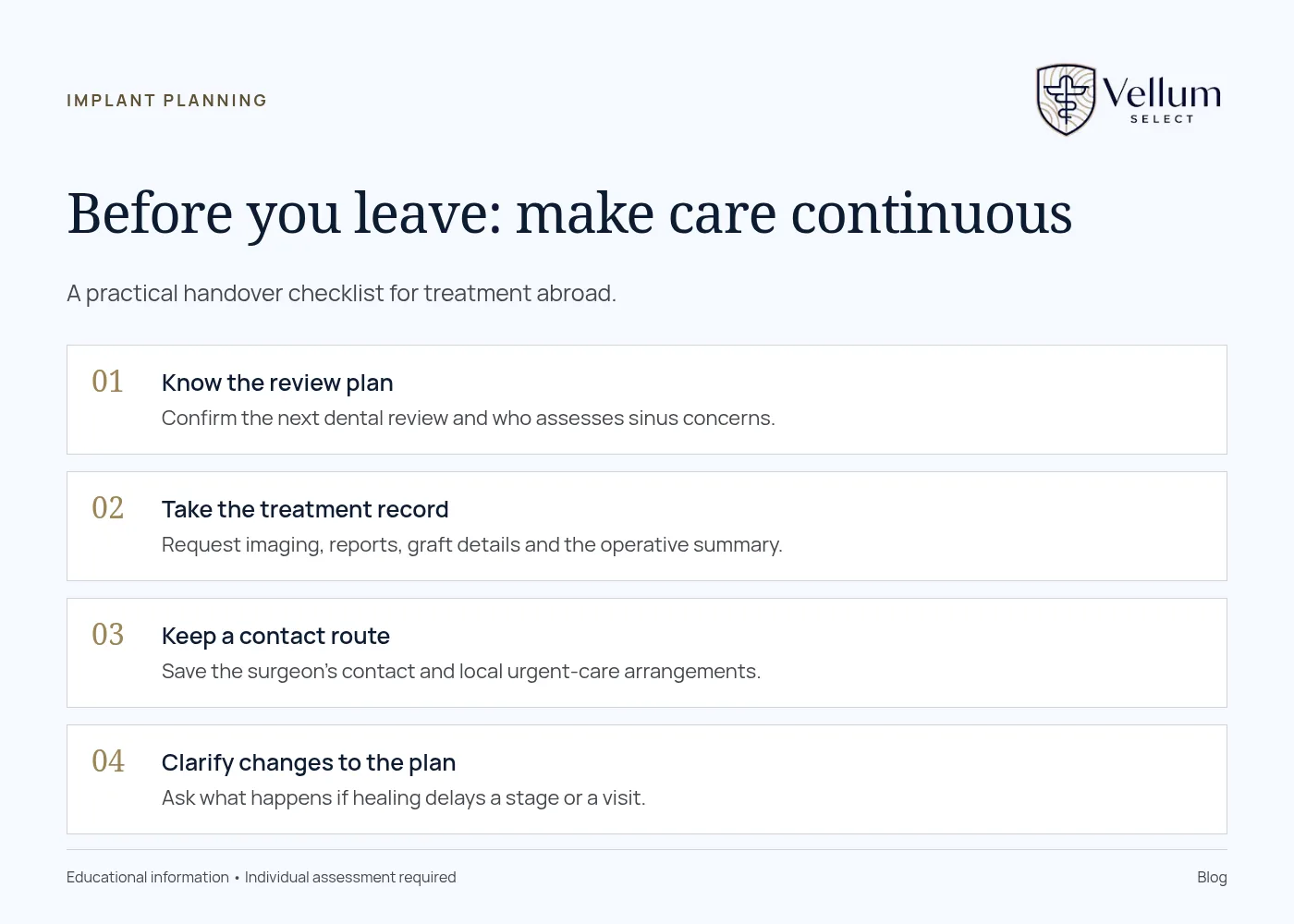
Before leaving, request copies of the operative summary, imaging and reports, graft details, implant details if applicable, medicine instructions and the follow-up plan. Ask for a named contact and a route for urgent out-of-hours help. These are practical handover requests, not a replacement for local assessment when symptoms need attention.
Longer-term implant care also requires cleaning and regular dental follow-up; completion of the final teeth does not end maintenance.[9] Agree who will provide routine checks and how new dental or sinus concerns will be communicated to the original team.
Questions to take to your consultation
- What finding makes augmentation relevant to my proposed restoration?
- Could another implant plan, bridge, denture or no replacement be considered?
- Does my sinus history need further assessment first?
- Why this approach and these graft materials?
- What would make you pause surgery or separate the stages?
- Who handles dental or sinus complications after I return home?
So, do you really need one?
Not everyone needs a sinus lift before implants. The answer belongs to an individual examination, appropriate imaging and a comparison of reasonable options.[1][9] Ask for a plan you can understand, including why augmentation is proposed, what might replace it and how care continues afterwards.
Use the linked Vellum Select treatment pages to frame your consultation questions, not to confirm a diagnosis online. A considered decision includes the option to seek another clinical opinion before committing.
Medical information, not personal advice: This article is educational and cannot determine whether you need augmentation or any other treatment.
Sources
- Sinus lift procedures — Cambridge University Hospitals
- Sinonasal complications following the sinus lift procedure — original case series
- Sinus lift and augmentation techniques — original expert survey
- Bone grafting and sinus lift — Vellum Select
- Dental implants — Vellum Select
- Bone grafting for dental implants — Guy’s and St Thomas’
- Dental implants in restorative dentistry — CUH
- Sinusitis — NHS
Travel and Recovery Planning