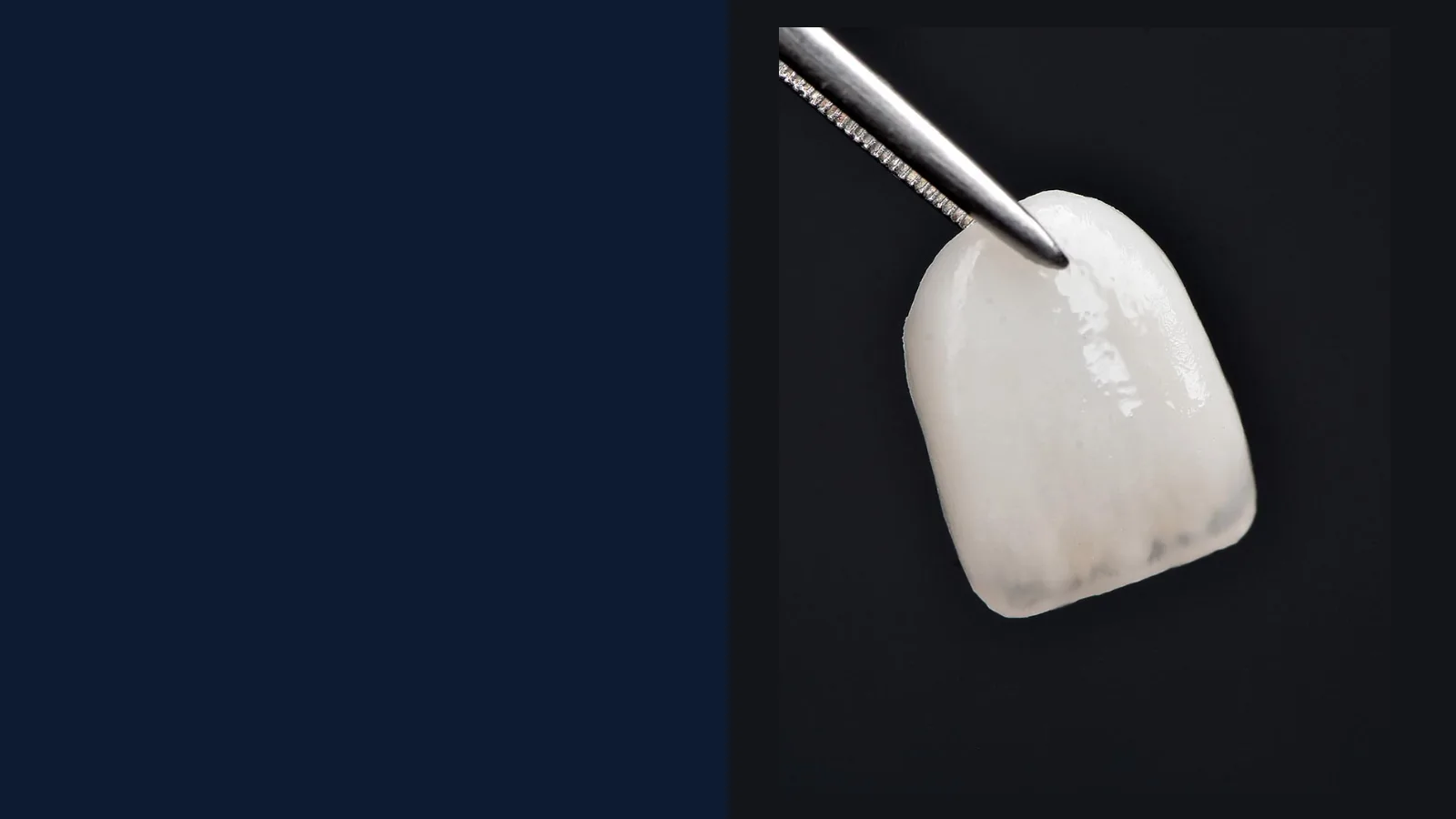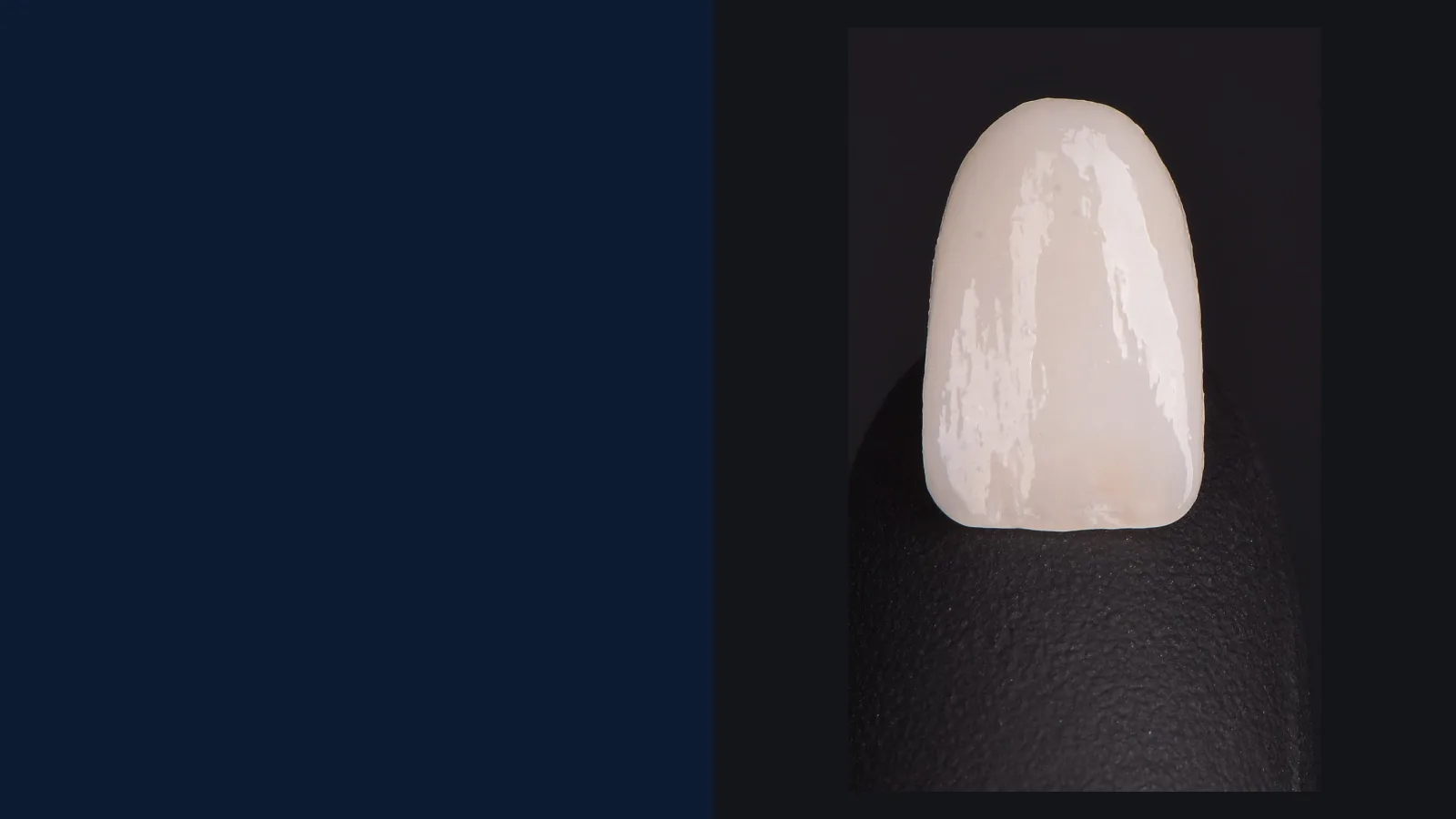
Understand the difference between restoration design and ceramic material, clarify e.max product names, and prepare questions about appearance, bite and follow-up.
If you are comparing emax veneers in Turkey with zirconia crowns, start by separating two decisions: what restoration a tooth needs, and which ceramic suits that restoration. A veneer and a crown are not interchangeable treatments. Veneers generally cover the front surface; crowns cover a tooth to restore its form and function.[4][5] Choosing a material before agreeing on the treatment can turn a useful comparison into the wrong question.
There is also a naming trap. IPS e.max CAD and IPS e.max Press are lithium-disilicate glass-ceramics, but the IPS e.max family also includes ZirCAD zirconia products.[1][2][3] An estimate that says only “e.max” does not identify the ceramic precisely enough. This guide helps you ask for a tooth-by-tooth explanation, rather than choose a whole smile from a material label.
1. First identify the restoration—not the package name
The first consultation question is: “What problem are we treating on each tooth?” Ask your dentist to distinguish an appearance concern from damage that needs structural restoration. The American Dental Association describes crowns as an option for problems including weakened or broken teeth and large fillings where insufficient tooth remains to support the filling.[5] That is a different rationale from changing the visible surface of an otherwise suitable tooth with a veneer.
Porcelain veneers ordinarily involve removing enamel from the front and sides of the tooth, and the ADA describes veneer treatment as irreversible.[4] Do not assume that a quote for “zirconia veneers” describes the same preparation as a quote for lithium-disilicate veneers. Ask whether the proposed restoration is genuinely a veneer, a partial-coverage restoration or a full crown, and request a diagram of the planned preparation.
A useful written plan has one line per tooth: the problem, proposed restoration, material, alternatives and reason for choosing it. Ask the clinician to show where sound tooth structure would be removed. If a recommendation changes from veneers to crowns, pause for an explanation rather than treating it as a simple upgrade. The consent conversation should be about treatment scope, not just an attractive shade or a familiar brand.
2. What “e.max” should mean in your treatment plan
IPS e.max CAD is milled from pre-crystallized lithium-disilicate blocks and then crystallized in a furnace. IPS e.max Press is lithium disilicate processed using a laboratory press technique.[1] These are different production routes within a related glass-ceramic category, not competing names for zirconia.
Ivoclar lists CAD applications that include veneers, inlays, onlays and crowns, with specific restrictions for bridges.[1] Press is supplied in different translucency and opacity options, which the manufacturer relates to different aesthetic and laboratory requirements.[2] Those indications show that lithium disilicate is not exclusively a veneer material. They do not show that every product is suitable for every tooth or every preparation.
Ask for the complete product name on the treatment plan and final laboratory record. If the dentist proposes Press rather than CAD, ask what that changes in your case: fabrication workflow, available shade options, layering approach or appointment sequence. Avoid assuming that “handmade,” “digital” or “same-day” automatically means a better clinical choice. Your useful question is whether the chosen workflow supports the restoration being prescribed.
Manufacturer documentation is appropriate for checking product identity and permitted uses. It is not independent proof that a branded material produces better results than every alternative. In this article, Ivoclar sources support those narrower product distinctions—not a claim of universal superiority.
3. Zirconia is a category with important variants
“Zirconia” also needs a fuller description. Within Ivoclar’s ZirCAD Prime family, Prime uses a combination of 3Y and 5Y zirconia, while Prime Esthetic combines 4Y and 5Y zirconia. The manufacturer describes different optical and mechanical characteristics across the disc and different application ranges for the products.[3] A single generic zirconia label hides those distinctions.
For example, the same official page lists crowns and three-unit bridges for Prime Esthetic, while Prime has a broader bridge application range.[3] That does not mean you should choose the broadest indication. It means the dentist and laboratory must match the exact product to the planned restoration and follow its current instructions.
Also ask whether the restoration is monolithic or includes a separate aesthetic ceramic layer. Ivoclar distinguishes fabrication approaches and notes a veneering-technique restriction for Prime Esthetic.[3] Here, “veneering” can describe layering ceramic over a restoration; it must not be confused with a thin veneer bonded to a natural tooth. Request plain-language clarification whenever a technical term appears to mean two things.
A practical response to a zirconia quote is: “Which manufacturer and product, which restoration design, and why is that combination appropriate here?” That is more informative than asking whether zirconia, in the abstract, is the strongest or the most natural-looking.
4. Appearance is a planning discussion, not a material slogan
Both product categories include optical choices. Ivoclar supplies lithium-disilicate Press ingots with different translucency and opacity options, including options intended for masking discoloured preparations; its ZirCAD family also varies shade and translucency within the material.[2][3] The simple slogan “e.max for beauty, zirconia for strength” therefore leaves out clinically relevant detail.
Bring photographs that help explain your preferences, but use them to discuss shape, brightness and character—not to request someone else’s exact result. Ask how the dentist will assess the underlying tooth colour, adjacent teeth and the proposed ceramic shade together. Where appropriate, ask whether a mock-up or provisional stage can help you discuss proportions before the final restoration is made.
Make the approval process explicit: when will you see the proposed appearance, what can still be changed at that stage, and what happens if you are uncomfortable proceeding? Ask how aesthetic preferences will be balanced with the restoration’s required design. A shade choice is not a substitute for a treatment explanation, and a photograph cannot establish which preparation is appropriate for you.
5. Strength figures cannot choose your treatment
Manufacturer strength figures describe material testing under stated conditions. The CAD page identifies its figure as a mean biaxial flexural-strength result from quality tests; the ZirCAD page distinguishes values by material zone and composition.[1][3] Treating such figures as a direct prediction of how long your particular restoration will last would go beyond what those measurements establish.
Instead, ask the dentist to connect the selection to the clinical plan: the restoration type, available tooth structure, required material thickness, bite assessment and intended fixing method. Ask which current product instructions govern those decisions. You do not need to choose a cement or preparation design yourself; you need a clear explanation that these decisions have not been reduced to a brand comparison.
If you clench or grind your teeth, disclose it before accepting cosmetic treatment. The ADA specifically cautions that veneers may not be a good choice for people who clench or grind or have a deep overbite.[4] Ask how those findings affect the proposed options and whether a protective or monitoring plan is appropriate. Do not interpret a switch to zirconia as a guarantee against complications.
6. Ask about alternatives and ongoing care
Before committing to ceramic treatment, ask whether no treatment, whitening, orthodontics, composite bonding or a more limited restoration could address your concern. These are discussion prompts, not a claim that every alternative is appropriate. Ask the dentist to explain why any simpler option is unsuitable, and what you would give up by choosing the proposed treatment instead.
Existing dental disease also matters. The ADA says decay and gum disease should be treated before veneers and warns that veneers can chip, crack, wear or loosen over time.[4] A cosmetic appointment should not bypass diagnosis or the opportunity to discuss those limitations.
Keep aftercare practical. Ask for written cleaning advice, what symptoms should prompt contact, and who will review the bite if it feels wrong. ADA veneer guidance advises telling the dentist when the bite does not feel right after placement and maintaining brushing and cleaning between teeth; cavities can still occur around or under veneers.[4] Neither ceramic eliminates the need for routine dental care.
Avoid a promised lifespan. Ask what maintenance, repair or replacement might involve, who would assess a problem and what costs could fall outside the original quote. Keep a written guarantee, if offered, separate from your understanding of clinical uncertainty.
7. Comparing emax veneers in Turkey with zirconia crowns
For an overseas consultation, compare equivalent plans—not just the totals. A veneer quote for one set of teeth and a crown quote for another are not a clean material comparison. Request the same tooth list, diagnosis, restoration description and exclusions before interpreting a price difference.
Build continuity of care into the decision. The ADA recommends considering follow-up and confirming insurance coverage for treatment after returning home.[6] NaTHNaC advises speaking directly to the treating professional, independently checking qualifications and discussing aftercare before booking treatment abroad.[7] These are planning checks, not evidence that any particular clinic or destination is safe or unsafe.
Ask for copies of your treatment plan, relevant images and final material details. Establish who will answer concerns after you return, how a local dentist can obtain records and who pays for additional treatment or travel if a problem develops. Do not rely on a coordinator’s reassurance in place of the treating dentist’s explanation.
Vellum Select’s dental veneers information and zirconium crowns information provide separate treatment context. Use them as starting points for questions, not as a diagnosis, a comparison of your personal options or independent evidence of outcomes.
A short consultation checklist
Take these questions to the dentist and ask for answers before committing:
- What is the diagnosis for each tooth, and why does it need treatment?
- Is the proposed restoration a veneer, partial coverage or a full crown?
- What tooth structure would be removed, and what alternatives are reasonable?
- Which exact ceramic product and design will the laboratory use?
- How do my bite, tooth colour and existing dental work affect the choice?
- When can I review the appearance, and what changes remain possible then?
- What are the limitations, aftercare arrangements and possible extra costs?
Keep the answers alongside your estimate. If the material name is clear but the treatment rationale is not, you are not yet comparing complete proposals.
Frequently asked questions
Is e.max always lithium disilicate?
No. IPS e.max CAD and Press are lithium disilicate, while IPS e.max ZirCAD products are zirconia.[1][2][3] Ask for the full product name rather than relying on the family name alone.
Can lithium disilicate be used for crowns?
Yes. Ivoclar lists crown applications for CAD and describes crown uses for Press.[1][2] Whether it is appropriate for a particular tooth still requires assessment and a product-specific plan.
Are veneers and crowns prepared in the same way?
No: they describe different coverage. The ADA distinguishes front-surface veneers from crowns covering the tooth and describes enamel removal for porcelain veneers.[4][5] Ask your dentist to explain the proposed preparation instead of inferring it from the ceramic name.
Which material lasts longer?
This guide does not establish a universal winner or a fixed lifespan. Ask for evidence relevant to the exact restoration proposed and an explanation of its limitations. Do not accept a laboratory strength number as a personal longevity promise.
Next step
Request an individual dental assessment and a written, tooth-by-tooth explanation before choosing ceramic restorations. The right comparison starts with the treatment you need—not the material being promoted.
Educational information only; not a diagnosis or personal treatment recommendation.
Sources
[1] https://www.ivoclar.com/en_gb/ipsemaxcad — IPS e.max CAD | Lithium disilicate block for CAD/CAM | Ivoclar > "Both materials are based on lithium disilicate glass-ceramic, but differ in processing:" [2] https://www.ivoclar.com/en_us/products/metal-free-ceramics/ips-e.max-press-lab — IPS e.max Press | Glass-ceramic restorations | Ivoclar US > "Five levels of translucency, plus Multi and Impulse ingots, offer different optical effects" [3] https://www.ivoclar.com/en_us/products/digital-processes/ips-e.max-zircad-prime-family — IPS e.max ZirCAD Prime | Zirconia Restorations | Ivoclar USA > "Blend of two zirconium oxide raw materials (3Y-TZP and 5Y-TZP) without any layers" [4] https://www.mouthhealthy.org/all-topics-a-z/veneers — Veneers | MouthHealthy - Oral Health Information from the ADA > "Treatment is not reversible because tooth enamel is removed to place a veneer." [5] https://www.mouthhealthy.org/all-topics-a-z/crowns — Crowns | MouthHealthy - Oral Health Information from the ADA > "Crowns can also be used to attach bridges, protect a weak tooth from breaking" [6] https://www.mouthhealthy.org/all-topics-a-z/travel — Travel | MouthHealthy - Oral Health Information from the ADA > "Continuity of care is important and should be a consideration when making treatment decisions." [7] https://travelhealthpro.org.uk/news/699/travelling-abroad-for-treatment — NaTHNaC - Travelling abroad for treatment? > "Ask them about aftercare and follow up and inform them of your full medical history"