A patient guide to looking beyond an implant brand name: understand the exact system, request usable records and plan maintenance and follow-up before travelling.
If you are researching straumann implants turkey, the useful question is not simply whether a clinic advertises a familiar name. It is whether the team can explain the exact system proposed, why it fits your treatment plan, which components will be used, and how another dentist could maintain it later.
Brand information matters because it helps identify a medical device. It does not replace diagnosis, informed consent or a workable aftercare arrangement. This guide uses Straumann’s own implant passport as an example of product documentation—not as independent evidence that one manufacturer produces better outcomes than another.[5]
For patients travelling for treatment, the aim is practical: leave with a clear plan before surgery and usable records afterwards. A recognisable brand on an advertisement is the beginning of that conversation, not the conclusion.
1. Understand what an implant system actually includes
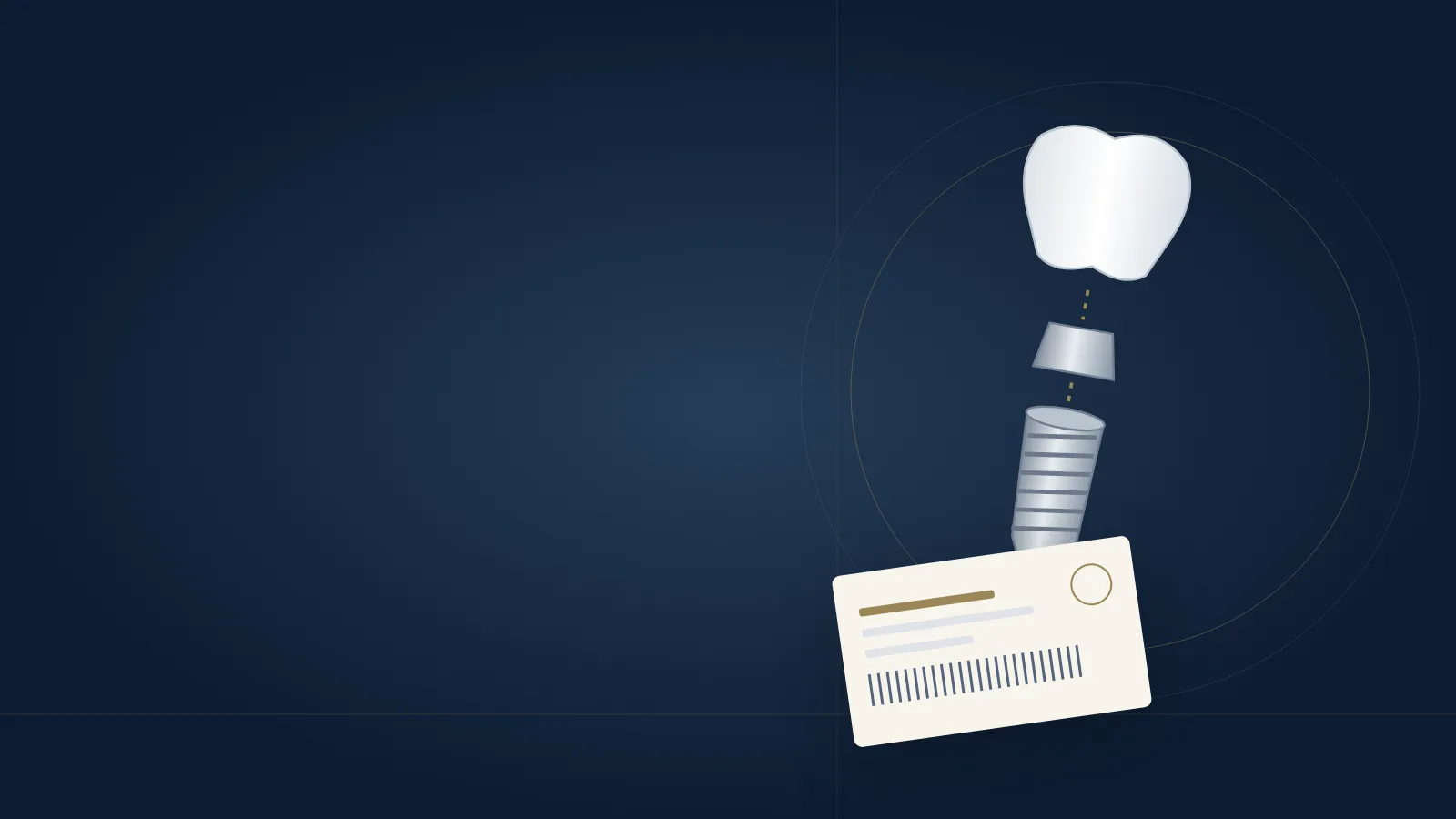
An implant is not the same thing as the visible replacement tooth. The NHS describes implant treatment as placing a titanium screw into the jawbone to support a crown, bridge or denture.[1] The connecting and restorative components deserve their own explanation, rather than disappearing into a package labelled “implant.”
Straumann’s patient-facing passport separates implant details from the restoration and abutment record. It also provides fields for the laboratory and material used.[5] That distinction is useful when reading any quotation: ask what goes into the bone, what connects to it, and what replacement tooth or teeth will sit above it.
Request an itemised description of the proposed work. If a quote says “Straumann implant,” ask whether that identifies only the implant fixture or also describes the connecting components. Ask separately about the crown, bridge or denture. Do not assume that naming the implant manufacturer identifies every part of the completed restoration.
2. Straumann is a manufacturer name, not a complete specification
The manufacturer’s passport lists different implant families, including BL, BLT, BLX, TL and TLX, alongside fields for diameter, length, surface and material.[5] These names identify product options; they are not a patient-facing ranking from ordinary to best.
You do not need to choose a technical specification yourself. Ask your dentist to translate the proposed system into a reasoned explanation for your case. Which implant family is planned? What clinical findings support that choice? Which aspects remain provisional until the examination or surgery?
Treat claims about a particular surface, material or design with the same care as any other treatment claim. Ask what the evidence relates to and whether it applies to the exact product and clinical situation being discussed. This article does not establish that Straumann, or any named family, is superior to other suitable systems.
3. Start with suitability, not a brand upgrade
A brand choice should follow an individual assessment. The General Dental Council advises patients considering treatment abroad to be assessed by a qualified dentist before receiving a treatment plan and cost estimate. It also recommends speaking to their own dentist before travelling.[2]
Use that consultation to discuss why an implant is being proposed, the reasonable alternatives, and the disadvantages of each option. If several teeth are involved, ask for the plan to identify the sites and the type of restoration, rather than treating “full mouth” as a sufficient description.
Risk assessment remains important whichever device is selected. The European Federation of Periodontology identifies poor oral hygiene, a history of periodontitis and smoking as important factors associated with implant failure and peri-implant disease.[3] Tell the dentist about your health, medicines, gum history and smoking, rather than assuming a premium-priced system makes those details irrelevant.
A useful question is: “What would make you change or postpone this plan, even if I have already chosen a brand?”
4. Request a record that identifies the device
An implant passport is a patient-held record, not a promise of success. Straumann’s passport asks the implant team to record information about the implant and restoration and tells patients to bring it to appointments.[5] A completed record is more useful than an empty branded booklet.
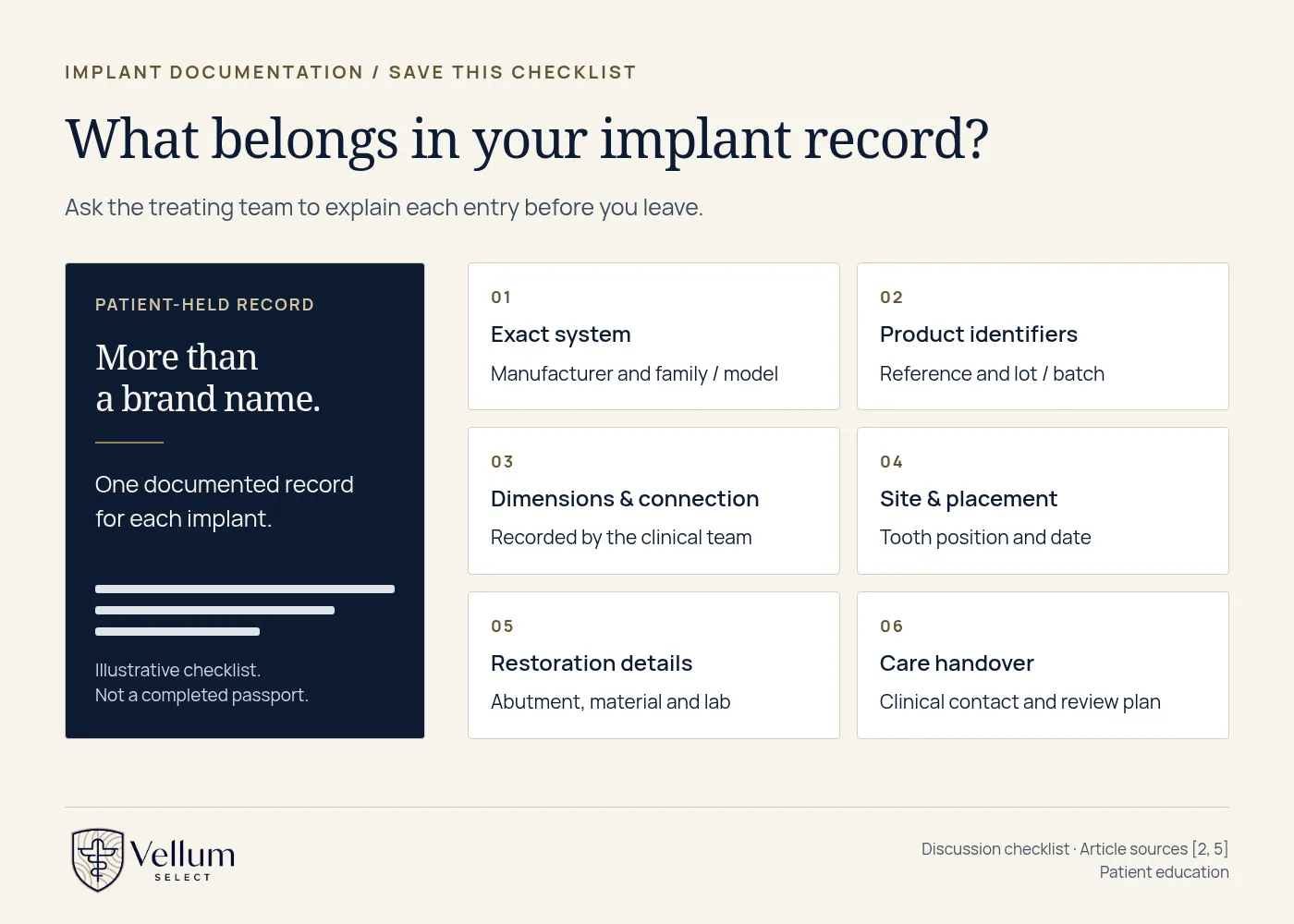
Ask the treating team which of these details will be supplied for each implant:
- Manufacturer and exact implant family or model.
- Product reference and lot or batch identification from the product documentation.
- Implant dimensions and relevant connection details.
- Tooth position and placement date.
- Abutment and restoration details, including the laboratory and material where applicable.
- Treating clinician’s contact details and the follow-up plan.
Straumann’s example includes reference and lot fields, dimensions, implant type and restoration information.[5] The checklist above is a request to discuss with your clinician, not a universal legal form or a guarantee that every record uses identical terminology.
Keep a readable copy with your treatment summary. Ask for an explanation of unfamiliar codes while the team has the records available. Do not post documents containing your personal health information in public comments to seek identification help.
5. Ask about compatibility without becoming your own technician
Knowing the manufacturer does not settle every component question. Straumann’s passport distinguishes different implant types and connection-related designations, and its manufacturer guidance cautions against combinations with third-party products.[5] That is a manufacturer position, not an independent comparison of every available component.
Ask the clinician to document the proposed abutment and restorative components, whether any are supplied by another manufacturer, and how their suitability for the specific system is established. If a component changes during treatment, request an updated record and explanation.
Do not attempt to select replacement screws, tighten parts or arrange a repair by matching photographs online. The practical patient task is to preserve the information a qualified dentist needs to evaluate the restoration. A product name without the relevant specifications leaves important questions unanswered.
6. Check continuity of care before booking travel
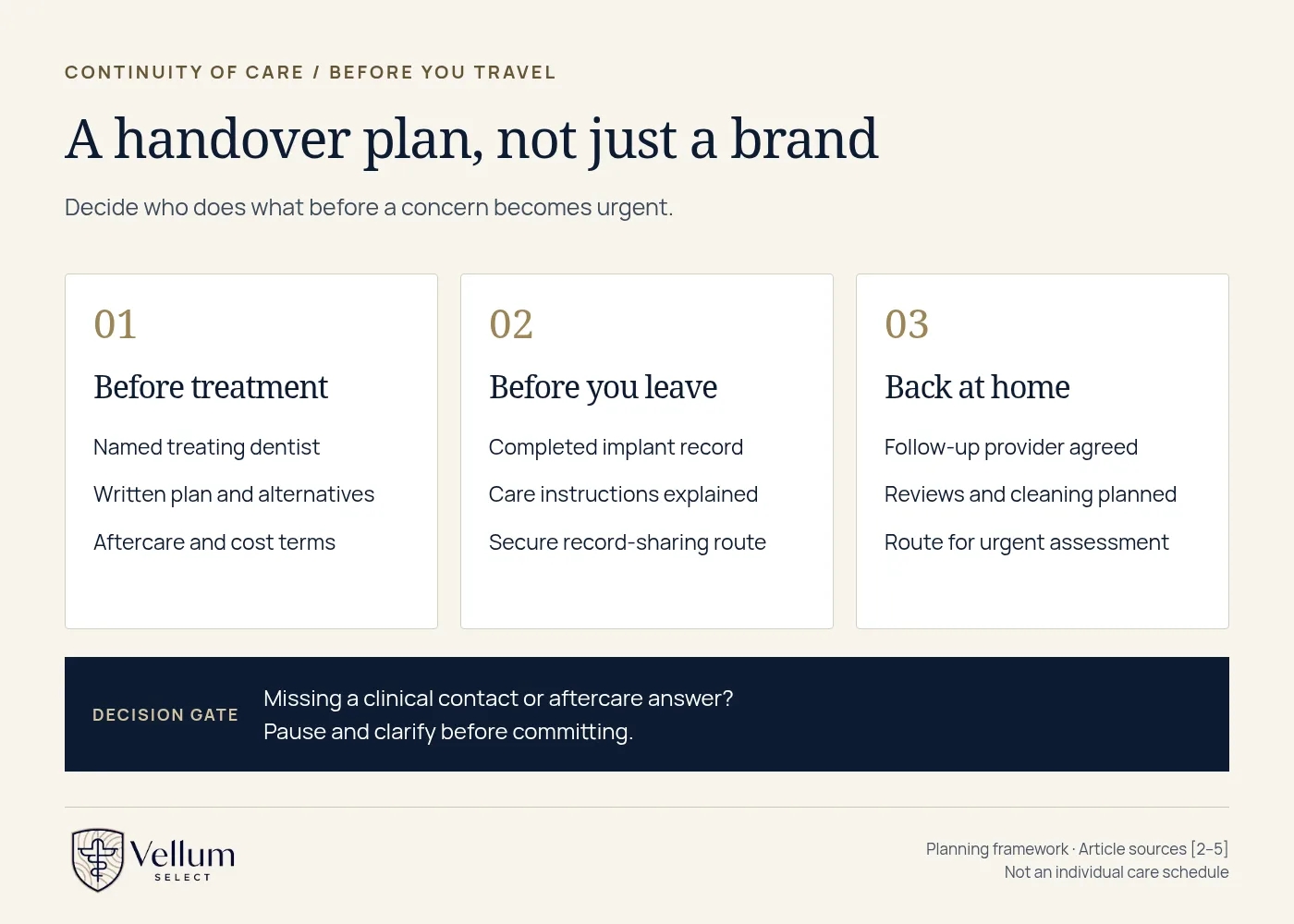
Think beyond whether treatment can be arranged in Turkey. Ask how the restoration will be monitored when you are back home and whether the intended follow-up dentist can assess and maintain the documented system.
The GDC recommends asking what aftercare is provided, who to contact if there are problems, and who pays for additional travel, accommodation or remedial treatment.[2] Those questions deserve written answers before a deposit becomes a reason to continue with an unclear arrangement.
Discuss what records can be shared securely with a dentist at home, how urgent clinical concerns will be handled, and when a return visit might be necessary. Separate coordination from clinical responsibility: who receives a message is not necessarily the person qualified to assess the problem.
International brand recognition should not be interpreted as a promise that every nearby dentist will accept your case, stock the relevant parts or provide free follow-up. Ask the intended provider directly rather than relying on that assumption.
7. Maintenance still matters after the restoration is fitted
An implant brand is not a substitute for cleaning and review. The EFP emphasises home oral hygiene, professional cleaning and regular appointments as part of preventing peri-implant disease.[4] Ask for cleaning instructions that address your actual crown, bridge or denture and for a follow-up schedule agreed with your clinician.
The EFP distinguishes inflammation of the tissues around an implant, known as peri-implant mucositis, from peri-implantitis, which involves inflammation and loss of supporting bone.[3] A familiar manufacturer name does not remove the need to monitor those tissues.
Ask the dentist to show you how to clean around the restoration and check that you can repeat the technique. Clarify which aids are appropriate and whom to contact if cleaning becomes difficult. Do not replace a personalised review plan with a universal timetable from an advertisement or another patient’s experience.
8. Know when to seek an assessment
The EFP lists increased bleeding during cleaning, gum swelling, bad breath or taste, and loosening of an implant or restoration as warning signs. It advises arranging an appointment promptly if signs of inflammation appear.[3] Do not wait for a scheduled overseas visit simply because your next routine review is already booked.
These signs are reasons for professional assessment, not a way to diagnose yourself. Ask for written postoperative instructions that distinguish expected recovery from concerns requiring contact, including an out-of-hours route. If symptoms are severe or rapidly worsening, use local urgent care rather than relying only on messages to a travel coordinator.
9. Read the proposal and guarantee as separate documents
A product warranty, a clinic’s remedial-care policy and your own travel expenses answer different questions. Ask for each applicable document rather than treating “guaranteed implants” as a complete explanation.
Before accepting terms, ask what event is covered, which components are included, what exclusions apply, what follow-up is required, and who pays for the clinical work and travel if a claim is accepted. The GDC’s guidance specifically encourages questions about guarantees and the costs of returning for additional treatment.[2]
For comparing proposals, build a simple table: planned system; implant sites; connecting components; final restoration; additional procedures; follow-up; records; and exclusions. Leave an entry marked “not yet confirmed” when the provider has not answered. An incomplete table is a reason for another conversation, not a reason to fill the gap with marketing language.
10. What Vellum Select’s current pages say
Vellum Select’s dental implants information lists Straumann among the systems its dentists use. This is a provider-stated claim on its public treatment page, not independent confirmation of the brand or product planned for a particular patient.[6]
Its Dr. Ersin Arıcan profile describes him as a prosthodontist practising at Clinic Prime Istanbul.[7] That profile alone should not be read as confirmation that he will use Straumann for your case. Ask the treating clinical team to confirm the current availability, exact proposed system and responsible dentist in your written plan.
The distinction matters: a website can describe a service, but your own assessment and agreed documentation must identify the treatment actually proposed.
Questions to take to your consultation
Use these prompts to turn a brand discussion into a care discussion:
- Why is an implant appropriate, and what alternatives should I consider?
- Which exact system and components are proposed, and why?
- What remains provisional, and how will changes be agreed and documented?
- Which passport, labels and treatment records will I receive?
- Who will provide maintenance and urgent assessment after I return home?
- What do the written remedial-care and guarantee terms actually cover?
If an essential answer is missing, pause before committing. A clear explanation should still make sense without a brand logo beside it.
Frequently asked questions
Are Straumann implants automatically the best choice?
This guide makes no such ranking. Straumann’s passport documents product options and records; it is manufacturer information, not independent proof of superiority.[5] The appropriate choice needs an individual clinical explanation.
Does an implant passport guarantee that nothing will go wrong?
No. Its purpose is documentation. Straumann asks the team to record implant and restoration information and patients to bring the passport to appointments.[5] Maintenance and monitoring remain important.[3][4]
Can I arrange all future care with any dentist?
Do not assume acceptance or availability. Discuss your plans with your own dentist and ask the treating provider about aftercare before travelling, as the GDC recommends.[2] Establish the intended handover rather than leaving it until a repair is needed.
A considered next step
For a Vellum Select enquiry, request a clinician-led explanation of the proposed system and the records and follow-up you would receive. Bring the questions above to the consultation. The aim is not to buy a brand name in isolation; it is to understand a documented treatment plan and its continuing care requirements.
Educational disclaimer: This article provides general information, not a diagnosis or an individual treatment recommendation. Implant suitability, risks, component selection and follow-up require assessment by a qualified dental professional.
Sources
- NHS — Dental treatments
- GDC — Going abroad for dental treatment
- EFP — Peri-implant diseases
- EFP — Peri-implant disease: Prevention
- Straumann — Patient Facing Implant Passport (manufacturer documentation)
- Vellum Select — Dental Implants in Turkey (provider-stated information)
- Vellum Select — Dr. Ersin Arıcan (provider-stated profile)
Safety and Patient Rights