A practical decision guide to a revision nose job: assessment, healing, realistic goals, nose-tip revision questions and planning follow-up.
If you are unhappy after a nose operation, the next step is not automatically another operation. It is a careful assessment of what is bothering you, how far healing has progressed, and whether a further procedure could offer a worthwhile improvement. A revision nose job (revision rhinoplasty) is surgery on a nose that has already undergone rhinoplasty; the aims may involve appearance, breathing, or both.[6]
The decision can feel more difficult the second time. You may be trying to understand an unexpected result while also weighing another recovery, more expense and the possibility of further disappointment. Those concerns deserve a consultation, not pressure to choose a package.
This guide explains the questions to work through before considering a revision nose job. It is a decision framework, not a test that can tell you whether you need surgery.
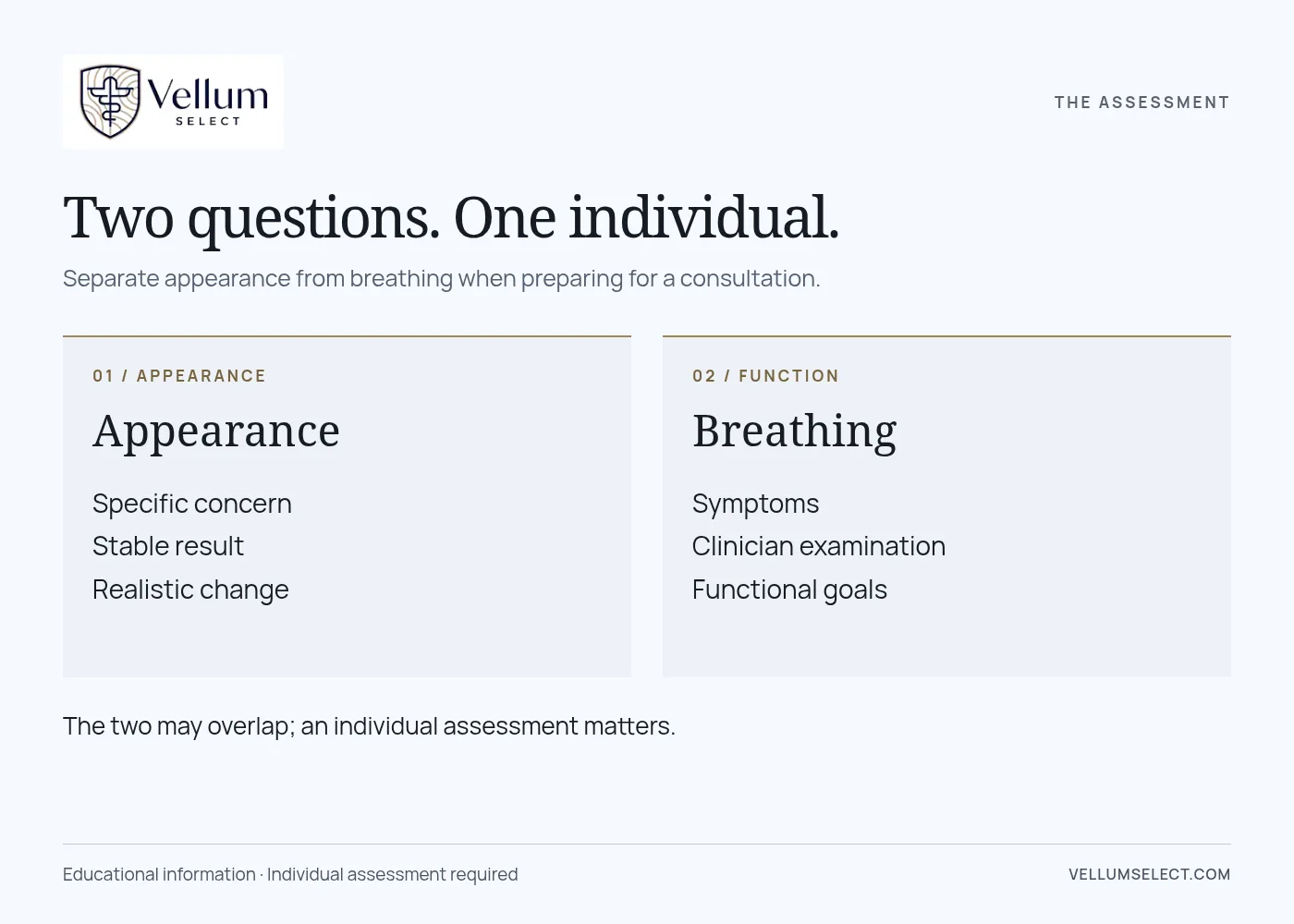
First, separate appearance from breathing
Start with two short lists: what you would like to look different and what you would like to function differently. In revision assessment, cosmetic and functional concerns should be considered separately even when they overlap.[4]
Your appearance list might describe one specific concern rather than a request for a completely different nose: an uneven outline, a tip you feel is unbalanced, or a change you have noticed over time. Write down what you see, when you first noticed it, and whether it is changing. Avoid trying to diagnose the cause from photographs.
Your breathing list should describe your experience: whether one side feels more blocked, when symptoms occur, whether they are improving or worsening, and how they affect you. Photographs do not replace examination of the inside and outside of the nose. A revision consultation may include assessment of the septum, nasal valves and surrounding tissues.[4]
Ask: “Which of my concerns can you explain from the examination, and which need more assessment?” That is more useful than starting with a particular technique or a promised new shape.
Healing is not the same as the final result
Early appearance is not a reliable deadline for another procedure. The American Society of Plastic Surgeons explains that initial swelling can settle within weeks while refinement of the nasal contour can take up to a year.[1]
For planned revision surgery, a clinical review recommends waiting at least a year in most cases so that healing and scar maturation can be assessed more reliably. It also describes selected situations in which earlier intervention may be considered. This is not a universal rule or automatic clearance at twelve months: the treating surgeon must decide the timing for the particular problem.[4]
Separate two questions:
- When should I ask for help? When you have concerns or unexpected symptoms; you do not need to wait for a calendar milestone to seek assessment.
- When, if ever, should another operation take place? After an individual evaluation and a discussion of the likely benefits, limitations and risks.
Keep follow-up appointments and ask the team to explain what they are monitoring. A practical question is: “What changes are you expecting during healing, and what would make you reassess the plan?”
When a revision nose job consultation may be useful
A consultation can help when a concern persists, affects breathing, or remains difficult to understand after discussing recovery with your original team. It does not commit you to surgery. The important question is whether there is a clearly assessed problem and a realistic goal, not simply whether you dislike a photograph.
For example, a discussion might focus on a persistent contour concern, a change in nasal support, or breathing difficulties. A specialist must establish what is actually causing the problem and whether another procedure could address it. Revision planning is more useful when the patient and surgeon agree on the concern and on the limits of correction.[4][6]
Try completing these sentences before the appointment:
- “The main thing I want help understanding is…”
- “The change that would matter most to me is…”
- “The outcome I am worried about is…”
- “If the improvement is likely to be limited, I would want to discuss…”
These are conversation prompts, not a way to qualify yourself for an operation. An honest consultation should leave room for observation, further assessment, another opinion or a decision not to proceed.
Revision nose tip surgery: questions about structure and grafts
A revision nose job is not necessarily a small repeat of the first procedure. Previous surgery can leave scar tissue and alter the available cartilage and supporting structures. The surgeon may need to work with those changes rather than simply make the nose smaller or refine one surface feature.[6]
Some cases require cartilage grafts to support or reconstruct the nasal tip or other parts of the nose. Depending on what is available and what the reconstruction needs, cartilage may come from the nasal septum, ear or rib. Not every revision requires rib cartilage, and the graft source should follow the clinical plan rather than a standard package.[6]
Ask why a proposed graft is needed, where it would come from, what additional recovery it could involve, and what alternatives exist. If a specific technique is recommended, ask the surgeon to connect it to your findings and goals rather than to a trend or a device name.
Revision nose tip surgery: realistic goals and limitations
An improvement is not the same as a guarantee of a particular appearance. Rhinoplasty carries risks and its results cannot be guaranteed; revision also involves working within the limitations of a previously operated nose.[3][6]
The discussion should cover the possibility that a concern cannot be fully corrected, that breathing may not improve as hoped, or that you could remain dissatisfied with some aspects of the result. General rhinoplasty risks include infection, poor healing or scarring, changes in sensation, difficulty breathing and the possibility of further surgery.[2]
Before deciding, ask the surgeon to explain the trade-offs in plain language:
- What is the main goal of the proposed operation?
- Which concerns are unlikely to change?
- Could improving one feature create a different limitation?
- How would a complication or an unsatisfactory result be managed?
Photographs and any simulated images should support that conversation, not replace it. Ask what they can reasonably illustrate about your own case rather than treating an image as a promised result.[7]
Prepare a useful consultation pack
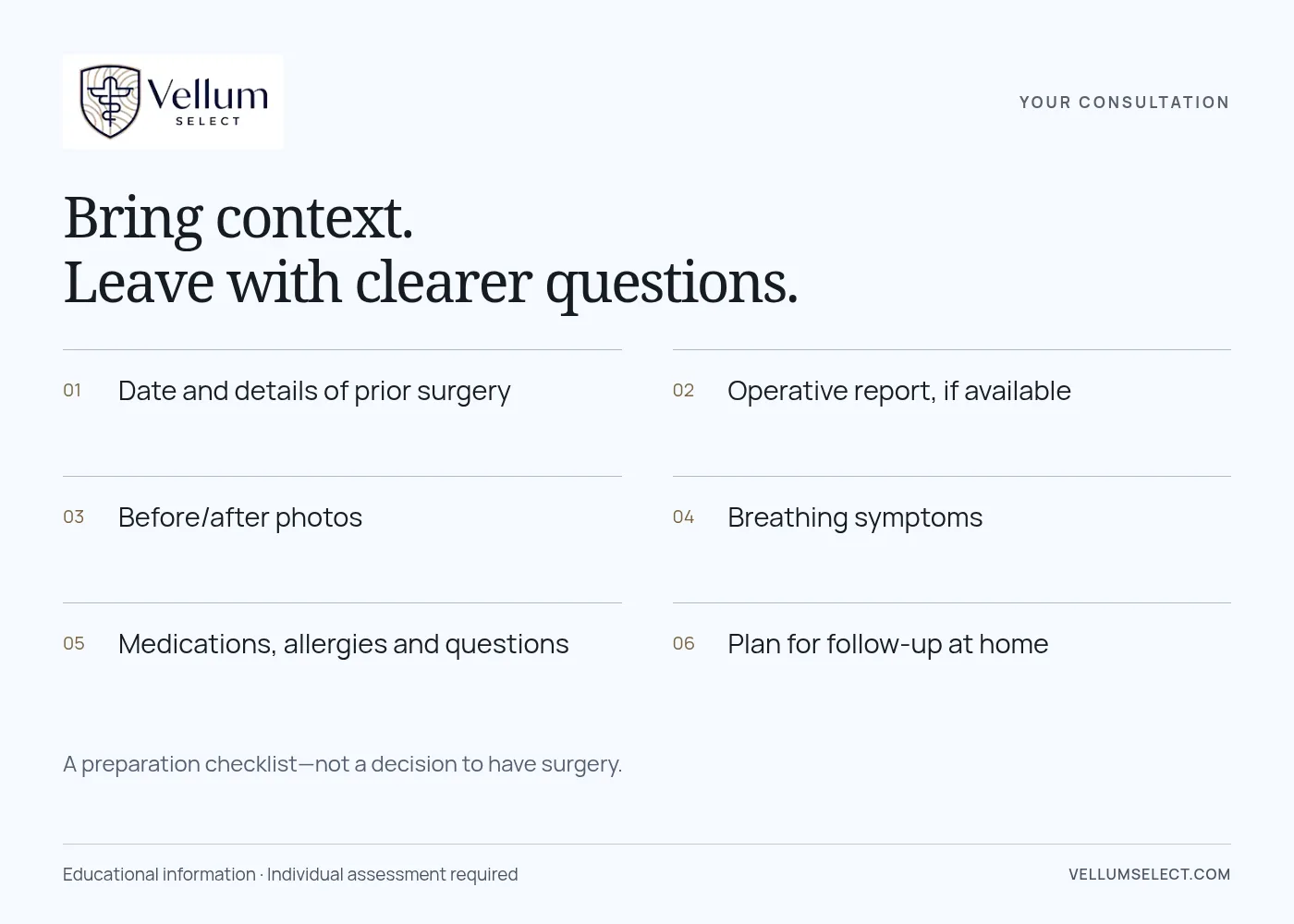
Bring the information you have from the first procedure, without worrying that a missing document means you cannot ask for help. Previous operative notes and before-and-after photographs can assist revision assessment, alongside a fresh examination and medical history.[4]
A practical pack includes:
- The date and location of every previous nasal operation.
- Operative reports, discharge information and details of any implants or grafts, if available.
- Dated photographs and a concise description of how your concerns have changed.
- Your breathing symptoms and any previous treatment or assessment for them.
- A current medication list, allergies and relevant medical history.
- The questions you want answered before discussing dates or payment.
Keep the pack organised so you can describe the sequence of events accurately. If you are sending medical records remotely, ask the clinic which secure channel to use and who will review them. Do not assume that a sales conversation or a photo-based estimate is the same as the surgeon's assessment.
Choosing a surgeon: questions that matter
Look beyond a polished gallery. Ask about the clinician's relevant specialist training, experience with revision cases, the facility where surgery would take place, and the process for managing complications. Professional guidance recommends discussing candidacy, technique, recovery, risks and options if you are dissatisfied with the result.[7]
For a revision consultation, make the questions specific:
- “How do you assess breathing as well as appearance?”
- “What makes my case more or less complex?”
- “What would make you advise against operating?”
- “Who will carry out the operation and the follow-up examinations?”
- “What happens if the findings or plan change after examination?”
When seeking care abroad, qualifications and regulation may differ from those in your home country. Ask how to check the surgeon and facility in the country where treatment will occur; do not assume that a familiar-looking professional title means the same thing everywhere.[8]
Planning a revision nose job abroad: care before travel
For international patients, aftercare is part of the decision before travel. The NHS advises checking where follow-up will happen, what happens if complications arise, and the practical and financial implications of needing further treatment abroad.[8]
Request a written plan covering:
- The consultation and examination arrangements.
- What the quoted treatment includes and what could cost extra.
- The follow-up visits expected before leaving Turkey.
- Who to contact outside routine hours.
- Who will assess concerns after you return home.
- What happens if the surgeon advises a longer stay or further treatment.
Do not treat a holiday itinerary as a recovery plan. Ask the surgeon for individual advice on activity and return travel rather than choosing a flight from a generic package length. Check insurance arrangements and possible exclusions before paying; do not assume ordinary travel insurance covers complications of planned surgery.[8]
Vellum Select's revision rhinoplasty information page is a starting point for exploring a consultation. Use the questions in this article to discuss the proposed pathway, and ask which clinician would assess your individual case. A destination or package should not determine the indication for surgery.
Do not wait for a revision appointment if you need urgent help
A planned second operation is different from urgent assessment after surgery. If you have a nosebleed that seems excessive, difficulty breathing, or bleeding accompanied by weakness or dizziness, seek urgent local medical care. NHS guidance also advises emergency assessment for a nosebleed that continues for more than ten to fifteen minutes.[5]
For other unexpected or worsening postoperative symptoms, contact your surgical team promptly and follow the discharge instructions you were given. If symptoms are severe or you cannot obtain timely help, use local urgent or emergency services rather than waiting for an overseas review. This article cannot assess a postoperative problem remotely.
Frequently asked questions
Does being unhappy mean I need a revision nose job?
No. Dissatisfaction is a reason to ask for an assessment, not proof that another operation is appropriate. Healing stage, examination findings, realistic goals and the balance of risk and benefit all matter.[1][4]
Can a revision nose job help breathing?
It may be considered when assessment identifies a problem that a procedure could address. Breathing concerns need a functional examination; a cosmetic change alone is not a promise of better airflow.[4][6]
Do I always need to wait a year?
Many planned revisions are delayed until at least a year after the first operation, but timing is individual and selected earlier interventions are described in clinical literature. That does not mean waiting a year to report a problem or seek medical advice.[4]
Will I need rib cartilage?
Not necessarily. Grafting needs depend on the existing structures and the planned correction. Ask which source of cartilage, if any, is proposed and why.[6]
Can I choose not to have another operation?
Yes. You can ask for more information, seek another opinion, or decide that the likely improvement does not justify the risks for you. Take time to understand the options rather than committing because a date or price is available.[3][7]
A better next step
Before choosing a second operation, aim to leave a consultation with three things: an explanation of your concern, a realistic account of what could change, and a clear plan for follow-up.
If you are considering a revision nose job, you can contact Vellum Select to ask about consultation arrangements and the records to prepare. Bring your questions to the treating surgeon. A well-informed decision may mean proceeding, waiting, investigating further or choosing not to have another procedure.
Medical information notice: This article is educational and does not provide a diagnosis, establish that you are suitable for surgery, or replace advice from a qualified clinician who has examined you. Seek urgent local care for severe symptoms.
Sources
- [1] https://www.plasticsurgery.org/cosmetic-procedures/rhinoplasty/results
- [2] https://www.plasticsurgery.org/cosmetic-procedures/rhinoplasty/safety
- [3] https://www.nhs.uk/conditions/cosmetic-procedures/cosmetic-surgery/nose-reshaping-rhinoplasty
- [4] https://pmc.ncbi.nlm.nih.gov/articles/PMC8186987
- [5] https://www.nhs.uk/conditions/nosebleed
- [6] https://www.plasticsurgery.org/news/blog/understanding-revision-rhinoplasty-and-why-patients-seek-out-this-procedure
- [7] https://www.plasticsurgery.org/cosmetic-procedures/rhinoplasty/questions
- [8] https://www.nhs.uk/tests-and-treatments/cosmetic-procedures/advice/cosmetic-surgery-abroad
Safety and Patient Rights