
A practical, evidence-based checklist for international patients considering treatment in Turkey—from verifying doctors and facilities to planning insurance, recovery, records and follow-up care.
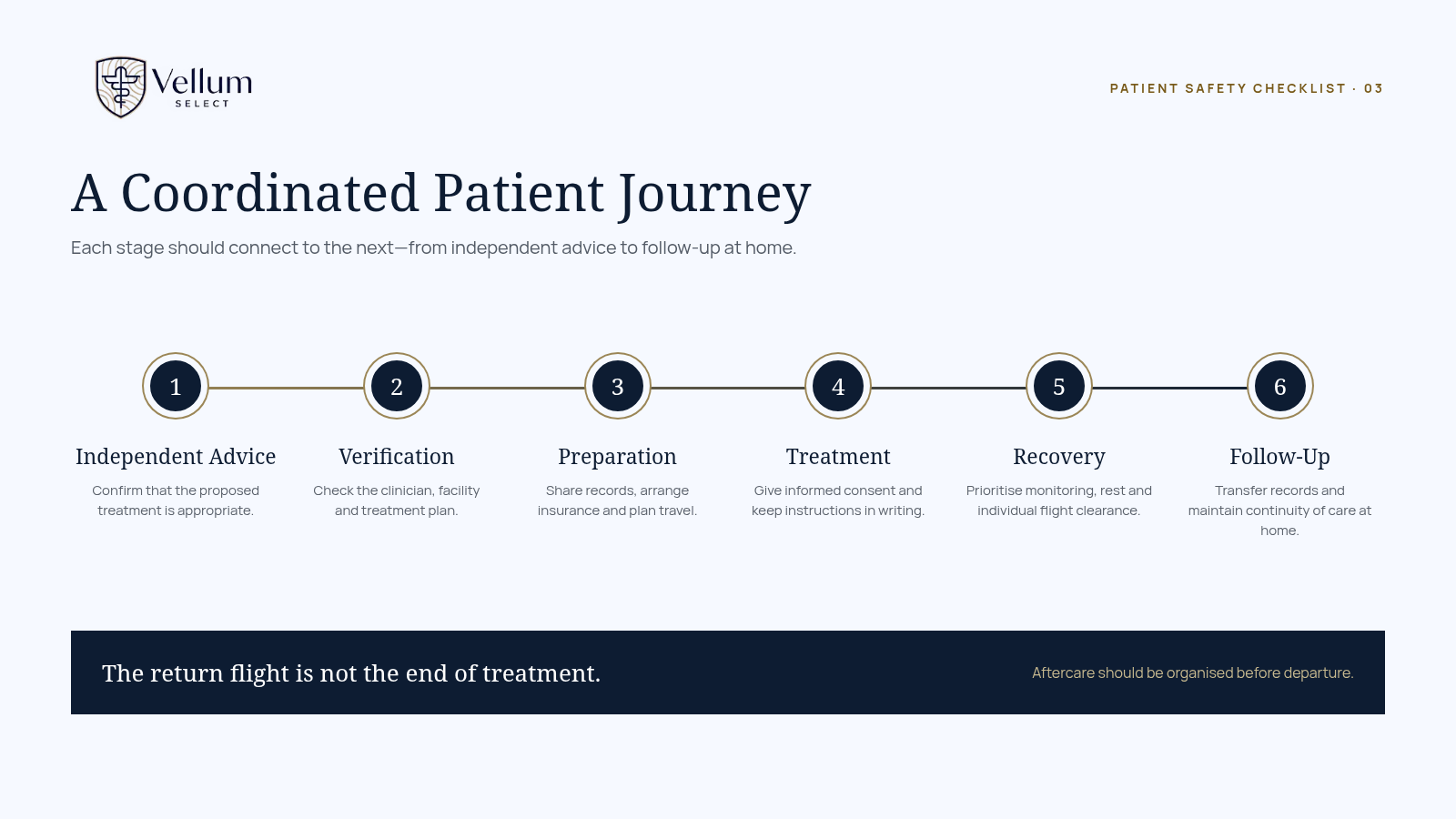
Travelling to Turkey for medical treatment involves more than choosing a doctor and booking a flight. The safest plans connect four parts of the journey: an appropriate treatment, a properly qualified clinical team, a suitable facility, and realistic arrangements for recovery and follow-up.
This checklist is designed to help you examine each part before paying a deposit. It cannot determine whether a treatment is appropriate for you, and it does not replace advice from a doctor or dentist who knows your medical history.
1. Confirm that the treatment—and the timing—are appropriate for you
Start with the clinical question, not the destination.
Ask your usual doctor, dentist or relevant specialist whether the proposed treatment is reasonable for your condition. A second opinion is particularly valuable when the procedure is invasive, irreversible, unusually urgent or significantly different from the options offered at home. The NHS advises patients to base decisions on the quality of care rather than the appeal of combining treatment with a holiday.[3]
Write down what you want the treatment to achieve and ask what a realistic result looks like. You should also understand the alternatives, including the option of delaying or not proceeding.
Ask before booking:
- What diagnosis is this treatment intended to address?
- What non-surgical or less invasive alternatives exist?
- What result is realistic in my individual case?
- What could happen if I postpone or decline treatment?
2. Verify the clinician’s identity and specialist credentials
Request the clinician’s full name, specialist field, registration details and relevant training. Confirm who will personally perform the procedure rather than assuming the person shown in an advertisement will be your treating clinician.
You should have a direct consultation with the clinician—or an appropriately qualified member of the clinical team—before making a final commitment. Use it to discuss your medical history, expected result, material risks and suitability. Be cautious if all communication is handled by sales staff and clinical questions receive vague or scripted answers.
Credentials are one part of due diligence. They do not guarantee a specific result, and no ethical provider should promise one.
3. Check the hospital or clinic independently
Ask for the exact name and address of the facility where treatment will take place. Confirm that it is appropriately licensed for the planned procedure and has the equipment, infection-control systems and emergency support your case may require.
HealthTürkiye is the official health-tourism portal whose information is verified by the Republic of Türkiye Ministry of Health. It includes searchable information about facilities and health professionals and can be used as one independent verification point.[4]
International accreditation can provide additional information about a facility’s systems, but it is not an outcome guarantee. The CDC recommends checking both the clinician’s qualifications and the facility’s credentials before travelling.[1][2]
Ask the facility:
- Where will the procedure and recovery take place?
- Who provides anaesthesia, if required?
- What emergency and intensive-care support is available?
- How are infections and complications monitored?
- Who is responsible for me outside normal clinic hours?
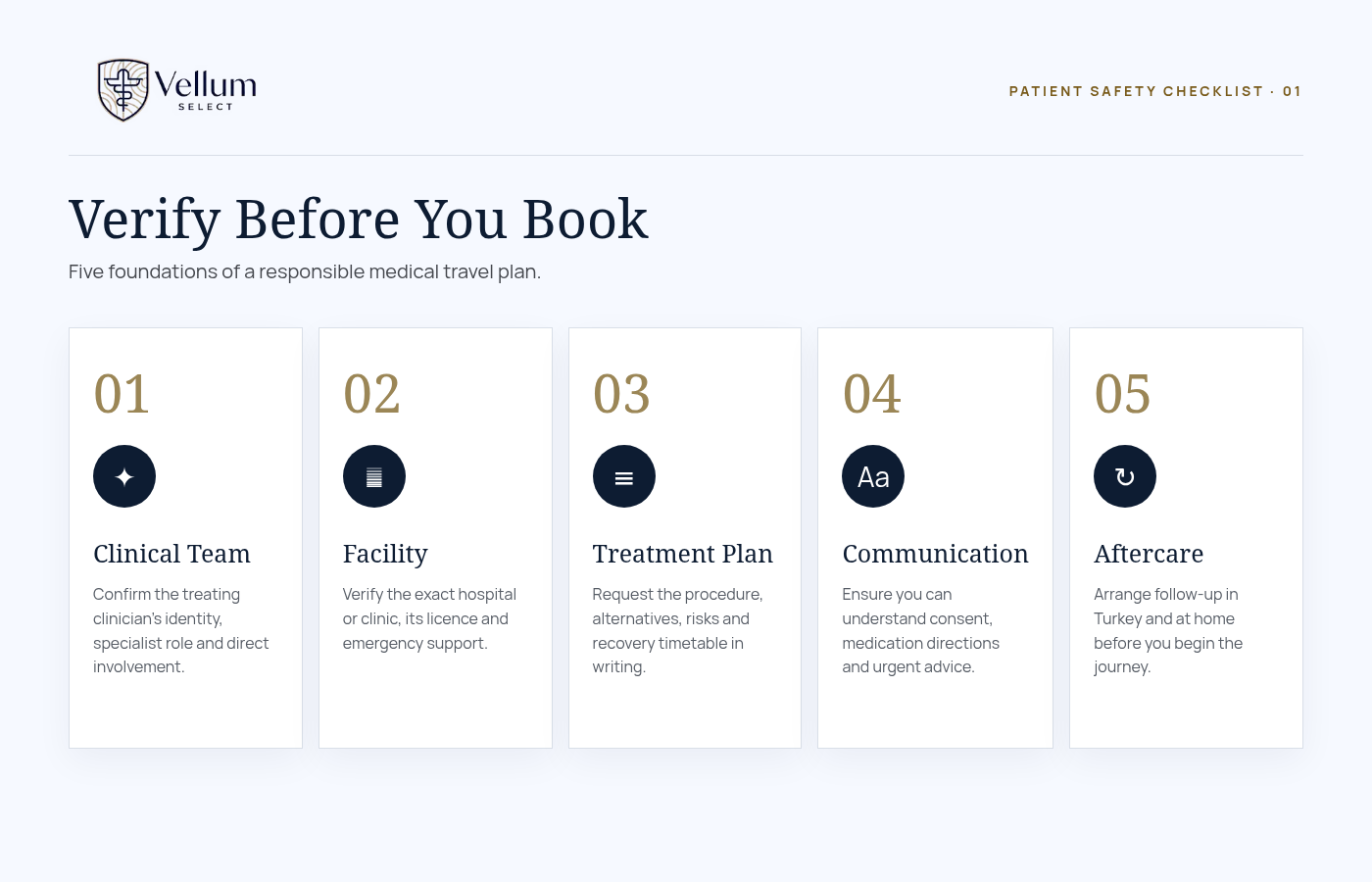
4. Obtain a written, personalised treatment plan
A quotation is not a treatment plan. Before paying, request a document that identifies:
- The proposed procedure or treatment
- Why it is being recommended
- The expected stages and approximate timetable
- The type of anaesthesia or sedation, if applicable
- Any implants, devices or materials expected to be used
- Common and serious risks
- Expected limitations during recovery
- The planned length of stay in Turkey
- The follow-up schedule
The plan may need to change after an in-person examination or new tests. Ask what kinds of findings could change the treatment, price or timetable and how your consent would be handled.
5. Disclose your complete medical history
Do not leave out information because it seems unrelated or because you worry that it could delay the procedure. Your clinical team should know about previous operations, chronic conditions, allergies, current symptoms, pregnancy possibility, smoking or nicotine use, alcohol intake, supplements and every medication you take.
The CDC advises medical travellers to discuss existing conditions and ensure they have enough regular medication for the trip.[1] Never stop prescription medicine—including medicines that affect bleeding—unless the clinician responsible for your care gives you specific instructions.
For a more detailed preparation guide, read Pre-Operative Preparation: What to Disclose Before Flying to Turkey for Surgery.
6. Arrange a pre-travel health consultation
Medical travel adds destination and transport considerations to the treatment itself. The CDC recommends consulting a healthcare professional or travel-medicine clinician well before departure; its current guidance uses a timeframe of approximately four to six weeks.[1][2]
The consultation should be tailored to your health, destination, procedure and recovery plan. Discuss routine vaccinations, prescription supplies, mobility, infection risks and any conditions that could affect flying or surgery.
If your procedure is scheduled sooner, seek advice as early as possible rather than skipping the consultation.
7. Confirm how you will communicate
Clear communication is a patient-safety requirement. Ask whether the clinician and nursing team speak a language you understand well enough for informed consent and urgent conversations.
If interpretation is needed, establish who provides it, whether it is available at all clinical appointments and how support works overnight or during an emergency. Do not rely on an accompanying child, a translation app or a salesperson to interpret complex consent discussions.
Request important instructions in writing, including medication directions, wound care, activity limits, emergency symptoms and contact details.
8. Get a complete written price—not only a headline price
Ask for an itemised quotation in writing. It should make clear what is included and what is not.
Check the cost of consultations, tests, anaesthesia, hospital fees, implants or materials, medication, accommodation, transfers, interpretation, follow-up appointments and changes to travel dates. Ask how additional treatment or an extended hospital stay would be charged if your recovery does not follow the expected timetable.
The NHS recommends accounting for exchange-rate changes, a longer stay and possible return trips when calculating the true cost of overseas treatment.[3]
A low starting price is not useful if essential clinical services or aftercare are excluded.
9. Understand insurance and financial responsibility for complications
Ordinary travel insurance often excludes planned treatment and complications resulting from it. Tell the insurer explicitly that the purpose of your trip includes medical or dental care and obtain written confirmation of what is covered.
Consider how emergency treatment, an extended stay, changed flights or medical evacuation would be funded. The CDC advises medical travellers to review both health-insurance coverage and supplemental medical or evacuation insurance before departure.[1][2]
Also ask the provider for its cancellation, complication and revision policies. These should be written in plain language and reviewed before payment.
10. Organise aftercare before leaving home
Aftercare is part of treatment, not an optional extra.
Ask who will review you in Turkey, how many in-person checks are planned, what remote support is available after you return and which symptoms require urgent assessment. Identify a doctor, dentist or specialist at home who can receive your records and assist if follow-up is required.
Both CDC guidance and the NHS treatment-abroad checklist emphasise planning continuity of care and understanding how complications will be managed.[1][2][3]
Do not assume your local public or private health service will automatically cover non-urgent follow-up arising from planned treatment abroad. Verify the arrangements that apply to you.
11. Plan recovery accommodation and support
Choose accommodation for recovery rather than sightseeing. Consider accessibility, stairs, distance from the treating facility, food, refrigeration for medicines and whether someone can remain with you when necessary.
Ask the clinical team whether you need an adult companion after sedation, anaesthesia or discharge. Build quiet recovery time into the itinerary. Alcohol, swimming, strenuous activity, long tours and sun exposure may be restricted depending on the procedure, and the CDC warns that typical holiday activities can interfere with postoperative healing.[1]
Treat tourism as optional. Recovery requirements come first.
12. Obtain individual clearance for the journey home
Surgery and prolonged immobility can each contribute to blood-clot risk, and flying too soon may create additional problems after some procedures. The safe interval before travel depends on the operation, anaesthesia, complications, mobility and your personal risk factors.[1][2]
Ask your treating clinician for a written fit-to-fly plan rather than relying on a package itinerary or a general number found online. Confirm:
- The earliest appropriate travel date for your case
- Whether compression garments or stockings are recommended
- How often you should move during the journey
- Whether you need mobility assistance at the airport
- How medicines should be timed across the travel day
- Which symptoms mean you should not board the flight
If your recovery changes, be prepared to postpone travel.
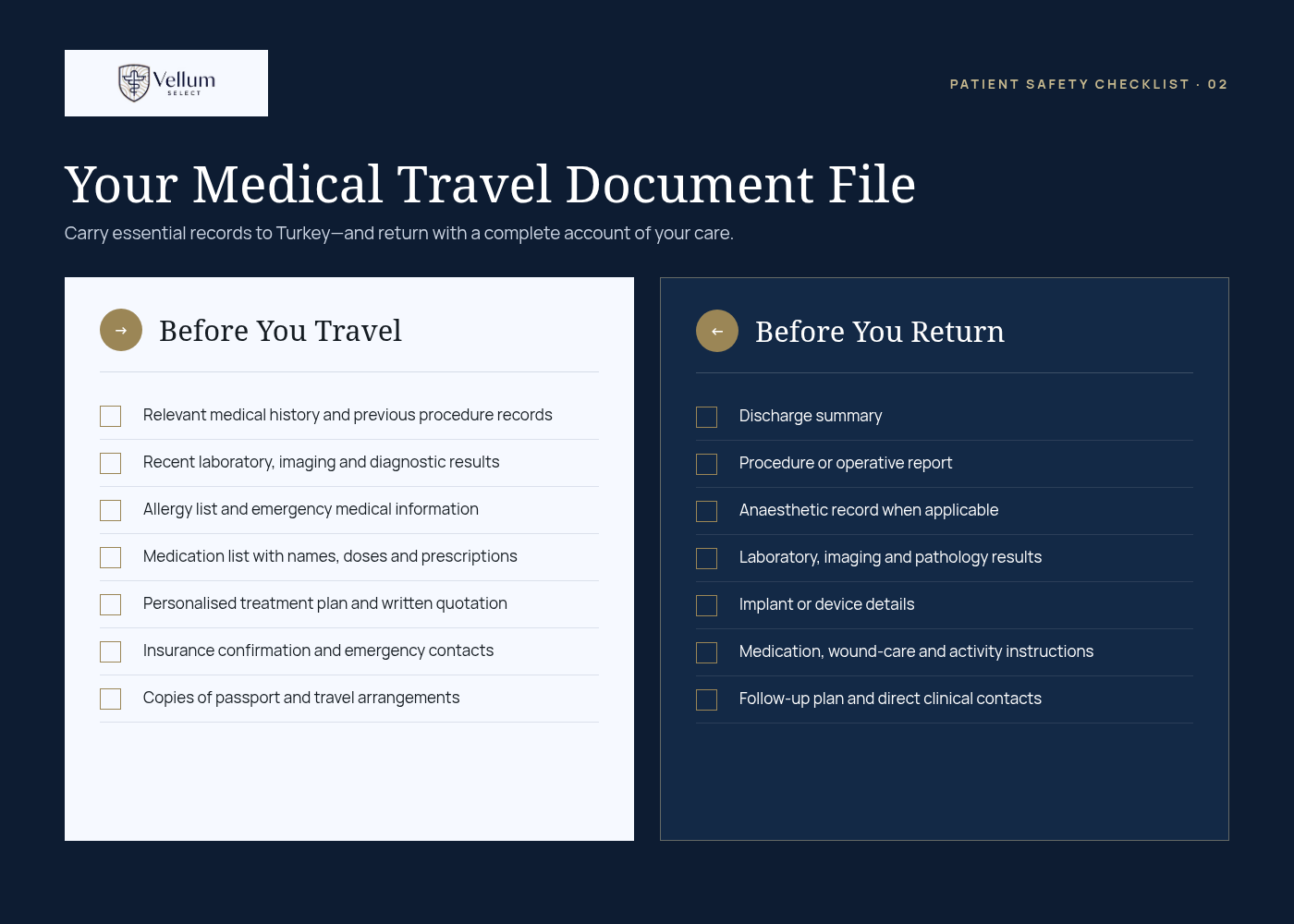
13. Carry the right records in both directions
Before departure, bring copies of relevant medical records, test results, imaging, allergies, prescriptions and a complete medication list. Keep essential documents and medicines in your hand luggage in their original packaging where possible.[2]
Before returning home, request a complete record of the care you received. Depending on the treatment, this may include:
- Discharge summary
- Operative or procedure report
- Anaesthetic record
- Laboratory, imaging and pathology results
- Implant or device details, including brand and reference information
- Medication list
- Wound-care and activity instructions
- Follow-up plan
- Direct clinical contact details
The CDC advises obtaining overseas records before returning and making them available in a language your follow-up clinicians can understand.[1][2]
14. Recognise pressure and other warning signs
Pause if you encounter:
- Pressure to pay immediately
- A discount that expires before you can seek medical advice
- No direct clinical consultation
- Guaranteed outcomes
- Little or no discussion of complications
- Unclear clinician or facility details
- A refusal to provide documents in writing
- No defined aftercare plan
- A holiday schedule that leaves inadequate recovery time
The NHS identifies hard selling, pressure to decide quickly, missing risk information and no mention of aftercare as warning signs.[3]
A professional provider should welcome reasonable questions. A deposit deadline should never replace informed consent.
For additional provider-selection questions, read How to Choose a Medical Tourism Agency and Is Turkey Safe for Medical Tourism? An Honest Guide.
15. Create a final go/no-go file
Before you book, collect the essential information in one folder that you and a trusted contact can access:
- Clinician and facility verification
- Personalised treatment plan
- Written quotation and payment terms
- Risk and consent information
- Insurance confirmation
- Travel and accommodation details
- Aftercare plan at home and in Turkey
- Emergency contact numbers
- Copies of medical records and prescriptions
- A flexible return-travel plan
If any essential answer remains unclear, delay the booking until it is resolved. A well-organised treatment journey should reduce uncertainty—not require you to ignore it.
Questions to ask during your consultation
- Why are you recommending this treatment for me?
- What alternatives should I consider?
- Who will perform each part of the procedure?
- Where will it take place?
- What are the most important risks in my case?
- What could change after an in-person examination?
- How long should I remain in Turkey?
- Who do I contact outside office hours?
- What records will I receive before travelling home?
- How will follow-up and complications be managed after I return?
Frequently asked questions
Is treatment in Turkey automatically safe if a hospital is accredited?
No accreditation system can guarantee an individual outcome. Accreditation can be one useful indicator, but it should be combined with verification of the clinician, facility, treatment plan, communication, emergency support and aftercare.[1][2]
How early should I seek travel-health advice?
CDC guidance recommends a pre-travel consultation approximately four to six weeks before the trip.[1][2] If you have less time, seek qualified advice as soon as possible.
Should I book flights before the treatment plan is confirmed?
Avoid committing to inflexible travel until the clinical team has assessed your information and provided a realistic schedule. Your return date should allow for recovery and should remain changeable if your clinician delays travel.
What documents should I receive before returning home?
Request a discharge summary and all records relevant to your treatment, including procedure details, test results, implant information, medication instructions and the follow-up plan. Ask for a version your home clinician can understand.[1][2]
Can I combine treatment with a holiday?
Sometimes limited activities may be appropriate, but the treatment and recovery plan must determine the itinerary. Ask the treating clinician which activities are restricted. Do not assume that swimming, sun exposure, alcohol, exercise or long tours are safe during recovery.[1][3]
A safer medical journey begins before the flight
The purpose of this checklist is not to eliminate every uncertainty; no medical treatment can offer that. It is to help you replace assumptions with verified information and a coordinated plan.
Vellum Select helps international patients understand their options, prepare questions and coordinate consultations with selected doctors in Turkey. If you are considering treatment and want to discuss the next appropriate step, contact the Vellum Select team.
Medical disclaimer: This article provides general educational information and is not medical advice. Suitability, risks, recovery and fitness to travel must be assessed by appropriately qualified healthcare professionals who know your individual history.
Sources
Medical Tourism in Turkey