A specialist-consultation framework for comparing Gamma Knife with medication and other procedures, understanding sensory risks and planning follow-up.
Consultation framework: diagnosis, treatment choices and follow-up.
Gamma Knife for trigeminal neuralgia is a form of stereotactic radiosurgery: focused radiation is directed at a small target on the trigeminal nerve to interrupt pain signalling. Despite its name, it is not an operation that opens the skull or uses a knife to cut the nerve.[4] It is one option within a wider treatment pathway, not an automatic replacement for medication or other specialist procedures.[2]
The useful question is not simply whether this technology can treat facial pain. It is whether your diagnosis, previous treatment, imaging and priorities make it appropriate to discuss. This guide offers a consultation framework rather than a recommendation for any individual. Use it to organise a specialist conversation, including what happens if relief is incomplete or pain returns.
1. Establish what is being treated
Trigeminal neuralgia affects a nerve that carries facial sensation. It can cause sudden, shock-like facial pain triggered by everyday activities; some people also experience ongoing aching or burning.[2] But facial pain has other causes, including dental and jaw conditions, and there is no single diagnostic test that establishes trigeminal neuralgia in isolation.[6]
Before considering a procedure, ask the clinician to explain the working diagnosis and what alternatives have been considered. A useful written summary should identify the affected area, the character of the pain and whether there is pain between attacks. Do not assume that a symptom description on a website establishes your diagnosis.
MRI may help identify blood-vessel compression or another cause, such as multiple sclerosis-related nerve damage or a tumour.[6] Ask who will review the actual images, not just the report, and whether additional imaging is needed for your assessment. The presence of an imaging finding needs clinical interpretation alongside your symptoms and examination.[4]
For background terminology, Vellum Select has a trigeminal neuralgia condition page.[9] Treat it as an introduction to a consultation, not as proof that a particular treatment is suitable for you.
2. Understand what radiosurgery changes
Gamma Knife delivers focused radiation rather than physically moving a blood vessel away from the nerve. The intended effect develops as a radiation-induced lesion interrupts pain transmission.[4] This differs from microvascular decompression, an open operation that aims to relieve pressure from a blood vessel touching the nerve.[1]
That distinction matters when comparing treatment descriptions. “No incision” does not mean “no effect on the nerve” or “no risk”. Facial numbness and pins and needles can occur after stereotactic radiosurgery, and sensory changes can be permanent or troublesome.[1] Discuss the balance between pain control and altered sensation explicitly, rather than treating sensory effects as an unimportant footnote.
Ask the team to describe the proposed target and the reason for choosing this technique in your case. You do not need to choose a radiation dose yourself. You do need an understandable explanation of the expected benefits, the uncertainties and the alternatives before giving consent. NICE supports use with appropriate governance, consent and audit arrangements, not without those safeguards.[3]
3. Place medication and other options beside it
Treatment commonly begins with medication. Antiseizure medicines such as carbamazepine or oxcarbazepine are among the options a clinician may discuss; procedures are considered when medication is insufficient or adverse effects are unacceptable.[2] A specialist consultation should review what you have tried, what helped and why a treatment was stopped.
Bring a medication history rather than a list of names alone: include prescribed doses, duration, benefit and side effects. Ask whether the medication pathway has been adequately explored, what monitoring is required and who will manage prescriptions. Some treatments require blood testing, and the balance of benefit and unwanted effects differs between people.[2] This article does not provide dosing or tapering instructions.
Other procedural discussions may include:
- Microvascular decompression: an open operation addressing blood-vessel pressure on the nerve. It requires general anaesthesia and carries important surgical risks, including hearing problems, stroke and other neurological complications.[1][4]
- Percutaneous procedures: balloon compression, glycerol injection or radiofrequency treatment reach the nerve through a needle or tube passed through the cheek and deliberately injure nerve fibres to reduce pain signalling.[2]
- Continued or adjusted medical management: this may remain part of the plan when a procedure is unsuitable, deferred or does not provide sufficient benefit.[1]
These are not interchangeable menu items. Ask the specialist to compare them using your diagnosis and health circumstances, including sensory risks, anaesthesia, possible recurrence and follow-up needs. A recommendation is more useful when it explains both why an option is favoured and why the alternatives are less appropriate.
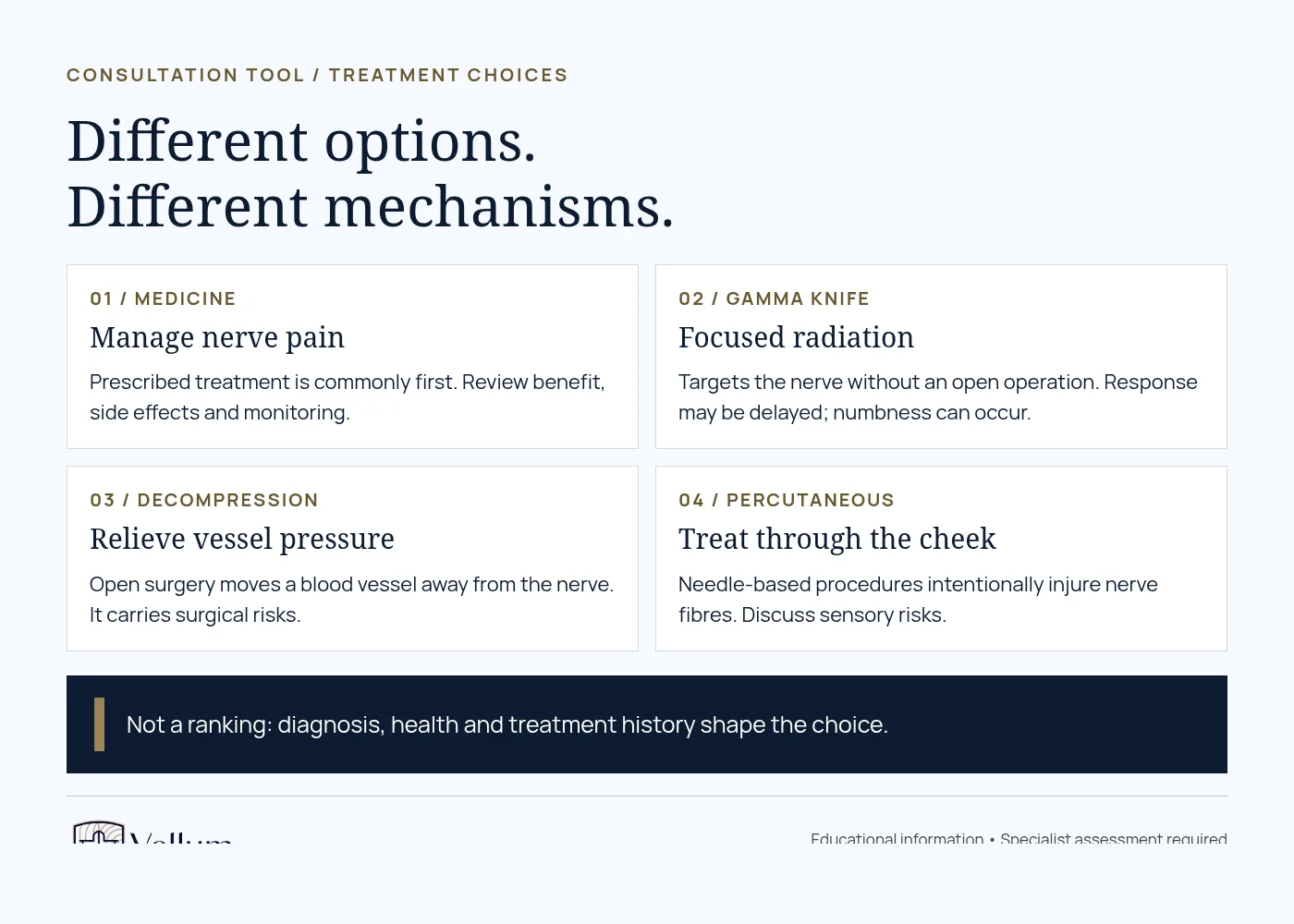
Different mechanisms require an individual comparison of benefits, risks and suitability.[1][2][4]
4. Ask how selection is made
NICE recommends selection by a multidisciplinary team experienced in trigeminal neuralgia and treatment in specialist centres.[3] In practical terms, ask which clinicians participate in the decision and whether the review includes access to both medical and procedural expertise. A technology-specific consultation should not prevent discussion of another treatment.
Specialist facial-pain services may involve neurologists, neurosurgeons and imaging expertise in coordinated assessment; UCLH describes an approach in which facial-pain care plans are developed by a multidisciplinary team.[5] This illustrates a model of care, not an assertion that every provider follows the same pathway or a statement about Vellum Select's clinical arrangements.
Ask how previous procedures, pre-existing facial numbness, other neurological conditions and your general health affect the recommendation. Request a written answer if the rationale remains unclear. If clinicians disagree, ask what the disagreement concerns: the diagnosis, the likely benefit, the procedural risk or the available alternatives. An unresolved diagnostic question is a reason for further assessment, not a reason to rush a booking.
5. Plan for delayed and variable response
Pain relief after stereotactic radiosurgery may be delayed and is not assured.[1][4] The treatment appointment and the therapeutic response are different events. Leaving the treatment centre does not establish that the pain has resolved, and an early lack of improvement needs interpretation within the team's follow-up plan.
Before treatment, ask how pain will be managed while waiting, who will assess worsening symptoms and when the team will review progress. Do not stop prescribed medication because a procedure has taken place; medication changes need an individual prescriber-led plan.[1] Request instructions you can use at home, in your preferred language, rather than relying on recollection of a discharge conversation.
Ask the team to define the outcome being discussed. Does “improvement” mean fewer attacks, less severe pain, reduced medication or complete relief without medication? What period of follow-up is being described? These questions help you interpret any figures a provider offers without treating results from another group as your personal forecast.
Pain can recur, and further medication or a different procedure may need discussion.[1] Include this possibility in the original decision rather than discovering it only after symptoms return. This guide intentionally gives no universal success percentage or promised response deadline.
6. Discuss sensory changes and warning signs
Ask how facial numbness or tingling might affect everyday comfort and what to do if a sensory change develops. Stereotactic radiosurgery can produce persistent sensory effects; pain relief and altered sensation need to be discussed together.[1] Tell the team about any existing numbness before treatment so it is not confused with a new symptom later.
A written safety plan should identify whom to call for new or worsening symptoms, including eye discomfort or changes in facial sensation, and which concerns require urgent assessment. Ask for advice specific to your proposed procedure, existing health conditions and medicines. An article cannot decide remotely whether a new symptom is an expected treatment effect.
Do not dismiss sudden face or arm weakness, speech problems or loss of sight as ordinary facial-pain symptoms. These can be signs of stroke and require immediate emergency medical help, even if they improve.[12] Use the emergency number where you are; do not wait for a travel coordinator or online consultation.
Medication safety also matters. The NHS identifies severe rash with blistering or ulcers as a possible serious reaction to carbamazepine requiring emergency care.[1] Seek urgent professional advice about concerning symptoms rather than changing treatment on your own. Tell your prescriber about pregnancy or pregnancy plans and any troublesome adverse effects.[1]
7. Prepare a consultation and continuity pack
AANS recommends recording the pain pattern, triggers, medication history, previous procedures and questions before a neurosurgical appointment.[4] Turn that information into a short pack that a clinician can review without having to reconstruct your history from scattered messages.
Include:
- A symptom summary: location, triggers, attack pattern and any pain between attacks.
- MRI images and reports, with the date and the facility that performed them.
- Current medicines, allergies, previous treatments and the reason each was changed.
- Relevant medical history, existing sensory symptoms and previous facial procedures.
- Your priorities: pain control, medication burden, preservation of sensation or practical support needs.
- Questions about alternatives, uncertainty, adverse effects and the plan if relief is incomplete.
For an assessment away from home, ask which clinician remains responsible after you return. Request a treatment summary, medication instructions, review arrangements and a contact route that works across borders. Ask whether your usual clinician will receive the records and who will respond if the treating centre is unavailable. These are planning questions to settle before booking, not promises about any provider's service.
Agree travel and activity arrangements individually with the clinical team. Do not use a generic same-day-discharge statement as permission to fly, drive or resume work. Ask what would change the plan and what additional accommodation or support you might need if the assessment leads to a different recommendation.
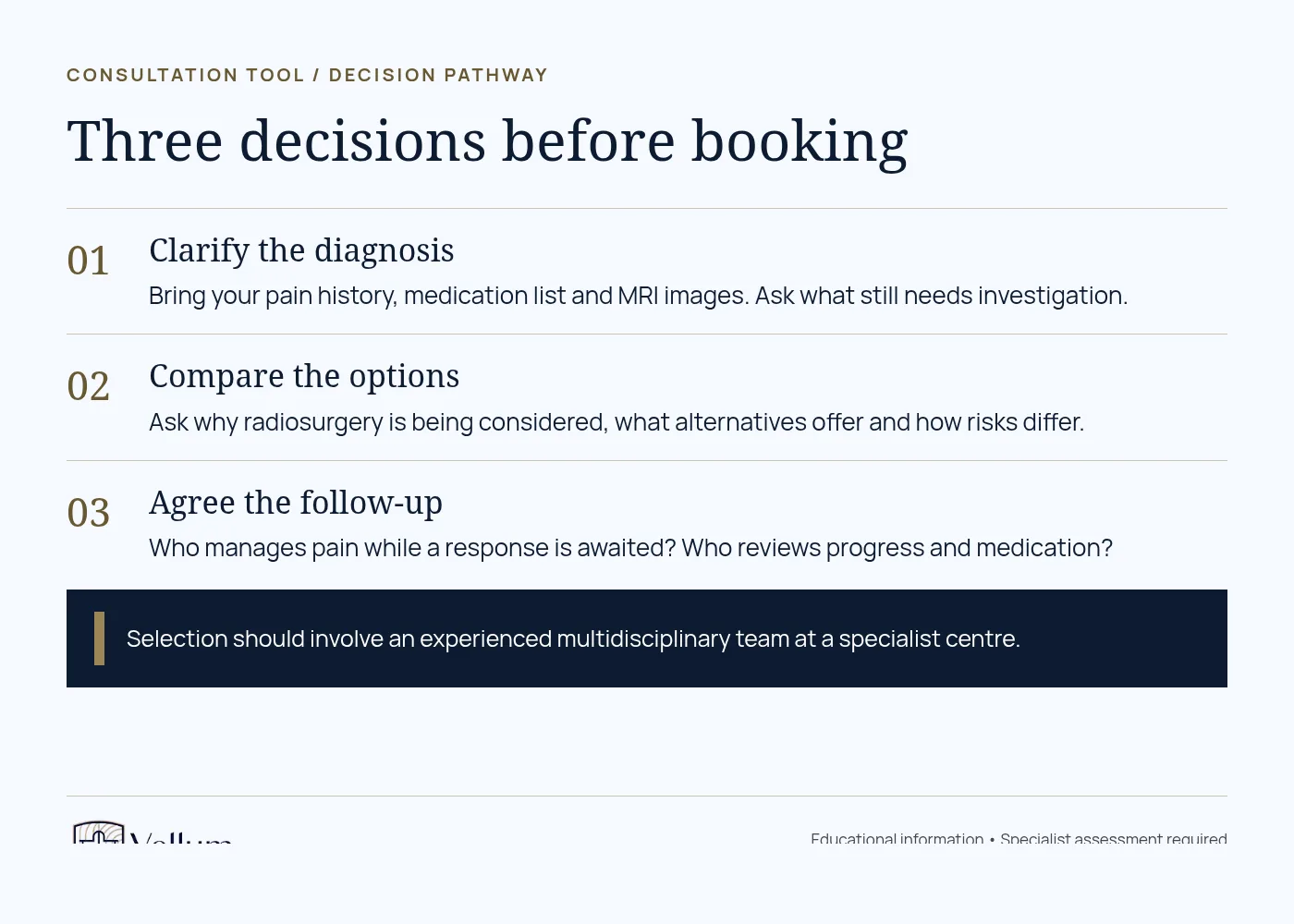
Use the pathway as a planning aid, not a self-selection test for treatment.[3][4][6]
Questions to take into the appointment
- What supports my diagnosis, and what remains uncertain?
- What does my imaging change about the available choices?
- Why consider Gamma Knife rather than medication adjustment, decompression or a percutaneous procedure?
- What benefits are realistic for my pain pattern and treatment history?
- What sensory changes or other complications should I understand?
- What is the pain-management plan while a response is awaited?
- Who reviews progress and decides on medication changes?
- What happens if pain persists, returns or changes character?
Ask for explanations in ordinary language and time to consider them. A useful consultation leaves you with a rationale, an alternatives discussion and a follow-up plan—not just an appointment date.
Frequently asked questions
Is Gamma Knife open brain surgery?
No. It is focused-radiation stereotactic radiosurgery, not an operation that opens the skull. Microvascular decompression is an open operation with a different mechanism and risk profile.[4]
Will it work immediately?
Not necessarily. Response can be delayed, benefit varies and some people do not obtain adequate relief.[1][4] Ask the specialist for an individual management and review plan rather than relying on a fixed deadline.
Can it replace medication permanently?
That cannot be promised. Whether medication can be reduced depends on the response and clinician assessment; pain may recur and further treatment may be needed.[1] Do not make medication changes independently.
A considered next step
If you are exploring assessment through Vellum Select, use its Gamma Knife information page to orient your enquiry.[8] Ask for specialist evaluation of your records and a written explanation of the options. A consultation is an opportunity to establish suitability, not a commitment to treatment or a guarantee of an outcome.
Medical disclaimer: This article provides general educational information, not diagnosis, prescribing advice or an individual treatment recommendation. A qualified treating clinician must assess suitability, benefits, risks, medication and follow-up. Seek local emergency care for urgent symptoms.
Sources
- [1] NHS — Trigeminal neuralgia: treatment
- [2] NIDCR — Trigeminal neuralgia
- [3] NICE HTG608 — Stereotactic radiosurgery for trigeminal neuralgia: recommendations
- [4] American Association of Neurological Surgeons — Trigeminal neuralgia
- [5] UCLH — Headache and Facial Pain Group
- [6] NHS — Trigeminal neuralgia: diagnosis
- [8] Vellum Select — Gamma Knife Radiosurgery in Turkey
- [9] Vellum Select — Trigeminal Neuralgia: Diagnosis & Treatment
- [12] NHS — Symptoms of a stroke
Safety and Patient Rights