Understand what each trip may involve, why provisional teeth differ from the final restoration, and what to confirm about healing, extra visits and aftercare.
Two trips can be a useful way to organise implant treatment abroad: one journey for surgery, followed by a return for the planned restoration after healing. But travel bookings are not a biological timetable. Implant treatment includes assessment, surgery, healing and restorative care, and each stage can involve several appointments.[1][5]
If you are searching for dental implants turkey two visits, the most useful question is not simply “How long between flights?” It is “What must be checked before the next stage, and who looks after me between visits?” This guide separates those decisions. It does not establish eligibility, promise immediate teeth or set a Vellum Select treatment interval.
1. Understand what “two trips” actually includes
A trip is a period spent in the treatment country. An appointment is a clinical encounter. A surgical stage is different again: some implants are placed with a component visible through the gum, while others need a later minor procedure to uncover them.[1] None of those terms means that the whole course consists of just two dental appointments.
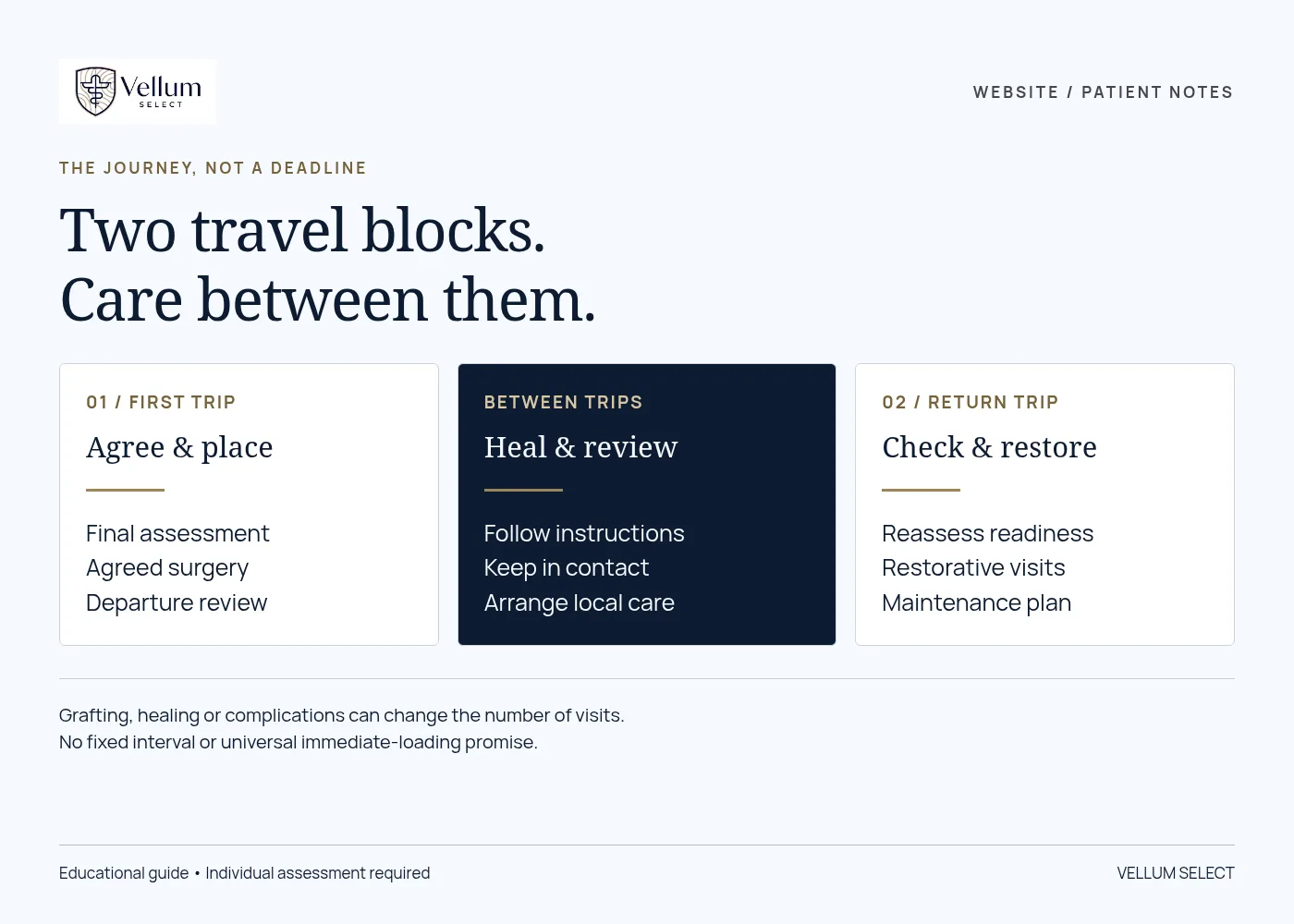
For planning, think of three connected phases: placing the implant, allowing bone to integrate with it, and fitting the replacement tooth or teeth. The American Dental Association describes this bone-healing process as osseointegration; the timing of attaching teeth varies between patients.[2] A two-trip proposal packages clinical work into travel blocks. It does not remove the healing phase.
Ask for a written itinerary that names the treatment at every appointment, the expected local review before departure, and the circumstances that would change the plan. Leave room in your budget for uncertainty rather than treating two return flights as the complete cost of care.
2. Before the first trip: agree the clinical plan
An assessment should explain whether implants are appropriate, what alternatives exist and what additional investigations are needed. Oral health and available jawbone matter; imaging and planning records may be required.[1] A remote conversation can help organise that assessment, but do not treat a provisional quote as confirmation that your mouth is ready for surgery.
Prepare your medical history, current medicines, previous dental records and questions about the proposed teeth. Tell the dental team about health conditions and medicines because these can change their advice.[5] Ask who performs surgery, who designs and fits the restoration, and who makes the final treatment decision after examination.
The brief should be specific enough to compare with a second opinion. Does it describe one missing tooth, a bridge, an implant-retained denture or a fixed full-arch restoration? Ask why each tooth is being retained, treated or removed. For broader background, Vellum Select’s dental implants overview explains the treatment category; use this article as the separate travel-and-handover checklist, not a substitute for an individual plan.
3. First trip: surgery, checks and a departure plan
The first travel block may include examination, final consent, implant placement and postoperative checks. Extractions or grafting may also be proposed, but their inclusion and sequence require individual assessment.[1][4] The clinic should distinguish work already agreed from decisions that remain conditional on findings.
An implant is the foundation placed in the jaw, not the visible replacement tooth. The restorative component may be a crown, bridge or denture.[5] Before consenting, ask the team to identify each item on a diagram and on the quote. “Implants included” should not leave you guessing whether the planned teeth are included too.
Before leaving, ask for written instructions on cleaning, food, medicines, activity and review arrangements. Confirm whether any stitches need attention and where this happens. Cambridge University Hospitals describes a postoperative review as part of its pathway; your own clinician must specify your arrangements rather than borrowing another hospital’s schedule.[1]
Do not choose the flight date solely around a hotel package. The NHS advises allowing suitable recovery time in the treatment country before travelling home.[3] Ask what would delay departure and how accommodation or travel changes would be handled. Keep the treating team’s emergency contact somewhere accessible without an internet connection.
4. Provisional teeth are not the final restoration
A provisional restoration is an interim solution, not evidence that all healing is complete. Ask whether the proposed temporary teeth are removable, supported by remaining teeth or attached to implants, and what restrictions apply. The ADA notes that some patients receive replacement teeth at implant placement, while others wait for integration.[2] That is not a promise that immediate loading is suitable for everyone.
Write down what you can expect to leave with after trip one. If a denture is involved, ask whether it needs adjustment or whether there will be a period when it cannot be worn; these issues can arise after implant surgery.[1] Discuss appearance, speech and everyday practicalities without assuming that a photograph of someone else’s temporary teeth describes your situation.
For the final restoration, ask what material and design are planned, how it is retained, how it is cleaned and what maintenance it needs. For extensive work, Vellum Select’s full-mouth restoration overview provides context for discussing the overall rehabilitation. A full-mouth plan should not be reduced to the number of implants alone.
5. Between trips: healing is an active care phase
The gap between journeys is not simply a waiting list for new teeth. Bone integration takes time, and the point at which a restoration can be attached differs between patients.[2] The treating dentist should explain how readiness will be assessed and what findings could postpone the next stage.
Ask for a between-visits care sheet with named contacts and a review plan. Who responds to photographs or questions? Which concerns require an in-person examination? Who can provide local care, and has that dentist agreed? Do not assume a remote message can replace every examination, or that a local practice has accepted responsibility merely because you listed its address.
Keep copies of the treatment plan, consent, imaging, operative notes and implant identification details. Ask the treating team which records the dentist at home will need, and agree how records can be shared. The NHS recommends discussing transfer of notes and coordination of aftercare before treatment abroad.[3]
Use this interval to follow the individual hygiene and maintenance instructions you were given. Long-term cleaning and dental follow-up remain important after implant treatment.[1][5] A temporary restoration and an apparently comfortable mouth do not remove the need for those reviews.
6. Second trip: confirm readiness, then restore
The return visit should start with clinical reassessment, not an assumption that enough calendar time has passed. Ask what checks are needed before the restorative stage proceeds. In staged surgery, a separate uncovering procedure may be needed before the replacement teeth can be made.[1]
Restorative work can include impressions or digital records, laboratory work and fitting appointments. The exact process differs for crowns, bridges and dentures, and can take several visits.[1][5] Request a schedule that allows for checking the proposed fit and bite, discussing cleaning access and making adjustments before departure. Ask how a laboratory delay changes your stay.
Before accepting the final restoration, request an explanation of what has been fitted and a demonstration of its care. Agree who will review any discomfort, movement, breakage or difficulty cleaning after you return home. Parts can loosen or wear over time, and delayed attention can cause problems.[5] “Final” describes a treatment stage; it does not mean maintenance-free for life.
7. When the two-trip model changes
Bone grafting is an important reason not to promise a universal itinerary. Some smaller grafts can be undertaken with implant placement; more extensive grafting can require a separate procedure and healing before implants are inserted.[4] Ask whether a sinus-related procedure or other preparatory surgery is being considered and how it affects your own sequence.
A practical question is: “If assessment shows I need grafting first, what happens to the proposed first trip?” Request a revised plan covering the number of journeys, review appointments, temporary teeth, costs and cancellation terms. Do not rely on a verbal statement that extra treatment can always be fitted into the original booking.
Treatment may also change if an implant does not integrate, if infection develops or if another complication requires assessment.[1][5] Ask the clinician to explain risks relevant to the proposed sites, including altered sensation and restorative problems.[1] Extra travel is not automatically evidence of poor treatment, but it should not be an undisclosed possibility.
8. Aftercare, complications and responsibility at home
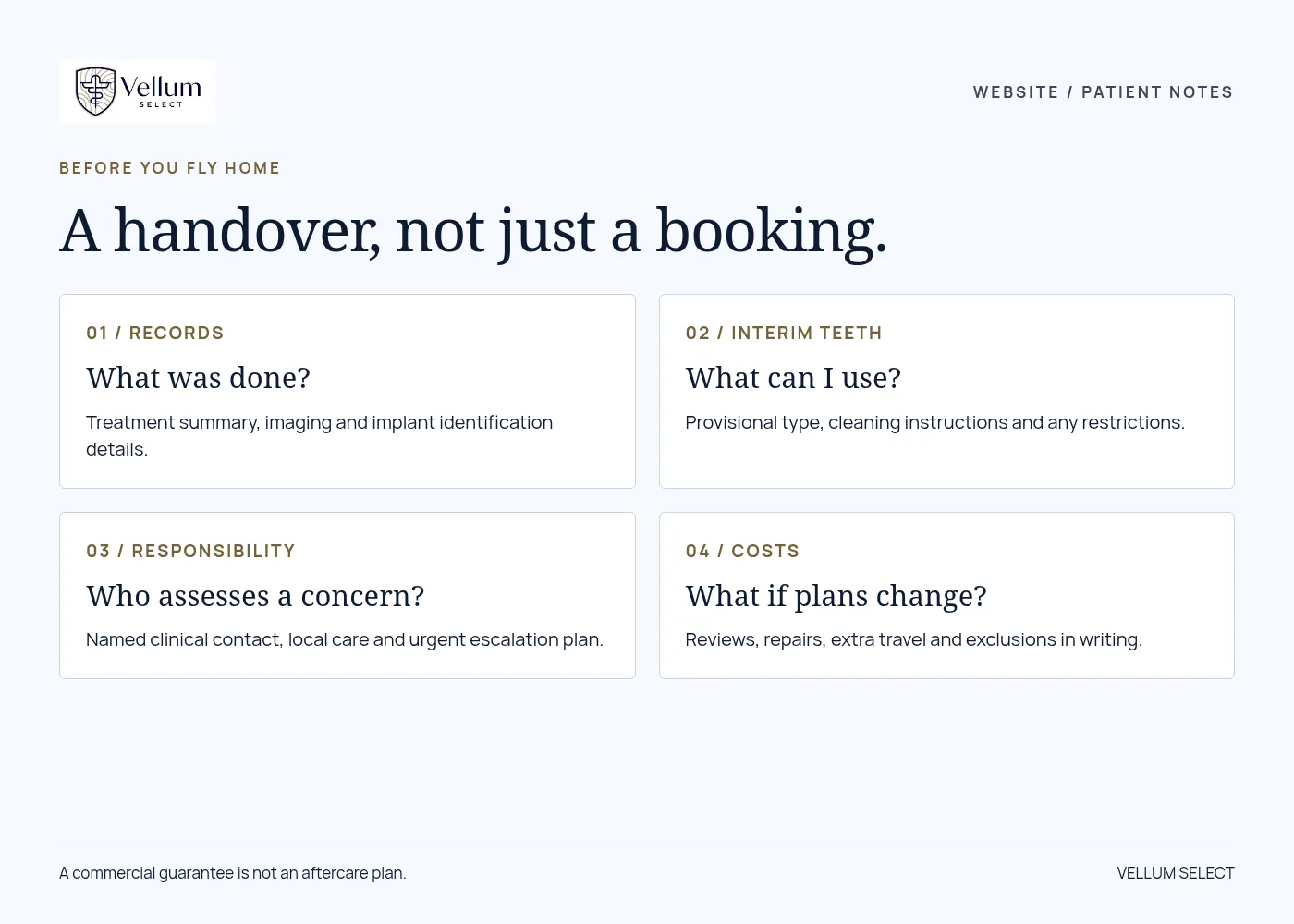
Agree a written handover before paying a deposit. Ask who assesses a concern, who authorises further treatment and who pays for local investigations, repairs or another journey. Separate the treating clinic’s obligations from any travel coordinator’s role. The NHS advises checking complications, aftercare, insurance and possible extra travel costs before treatment abroad.[3]
Request clear instructions for urgent problems, including persistent bleeding, increasing swelling, worsening pain, fever, altered sensation or a loose restoration. These are prompts to obtain professional assessment, not a self-diagnosis checklist. Implant and graft procedures have recognised complications, and the treating clinician must tailor escalation advice to the procedure.[1][4] For severe symptoms or an immediate threat to breathing, seek emergency help where you are rather than waiting for an overseas reply.[6]
A guarantee is not the same thing as an aftercare arrangement. Ask what it excludes, whether review by another dentist affects it, and whether travel and accommodation are covered. Keep the answers with your consent documents. Do not postpone needed assessment to protect a commercial promise.
Questions to take to your consultation
- What specifically happens during each trip, and how many appointments are expected?
- What could make two trips unsuitable or require a longer stay?
- What teeth will I use between visits, and what restrictions apply?
- What evidence will you use to decide I am ready for the restoration?
- If grafting is needed, which steps and costs change?
- Who provides care at home, and what records will they receive?
- What is included for both provisional and final teeth, reviews and adjustments?
- What happens if I cannot travel on the proposed return date?
Ask for answers in writing and take time to compare them. Pressure to decide quickly, missing complication information and absent aftercare are warning signs highlighted by the NHS.[3]
Frequently asked questions
Does two trips mean two appointments? No. Clinical stages can involve several appointments within each travel block.[5] Ask for both an appointment schedule and a travel plan.
Can everyone have fixed teeth on the first trip? No universal promise is justified. Timing of attaching replacement teeth varies, and an individual assessment is needed.[2] Confirm the proposed interim arrangement before booking.
Is there a fixed interval between trips? This guide deliberately gives none. Healing, additional procedures and the chosen restoration affect the sequence.[1][4] Your treating dentist must confirm timing and reassess readiness.
What should I ask Vellum Select for? Request a consultation and a written, clinician-confirmed plan that separates surgical care, interim teeth, final restoration and aftercare. Use the questions above to make the discussion specific; do not book around an assumed two-trip guarantee.
Medical information disclaimer: This article is educational, not individual dental advice or confirmation of suitability for treatment or travel. A qualified treating dentist must assess your circumstances, discuss alternatives and risks, and confirm your treatment and aftercare plan.
Sources
- [1] Cambridge University Hospitals — Dental implants in restorative dentistry
- [2] American Dental Association — Implants
- [3] NHS — Treatment abroad checklist
- [4] Cambridge University Hospitals — Bone grafting for dental implants
- [5] Guy’s and St Thomas’ — Dental implants
- [6] NHS — Dental abscess: urgent and emergency signs
Travel and Recovery Planning