Endoscopic Facial Lifting in Turkey
FREE PRE-EVALUATION
Upload your Photos, X-Rays or MRI Reports to request analysis from a specialist.
Consultant Status: Online
Minimally Invasive Rejuvenation with Endoscopic Precision
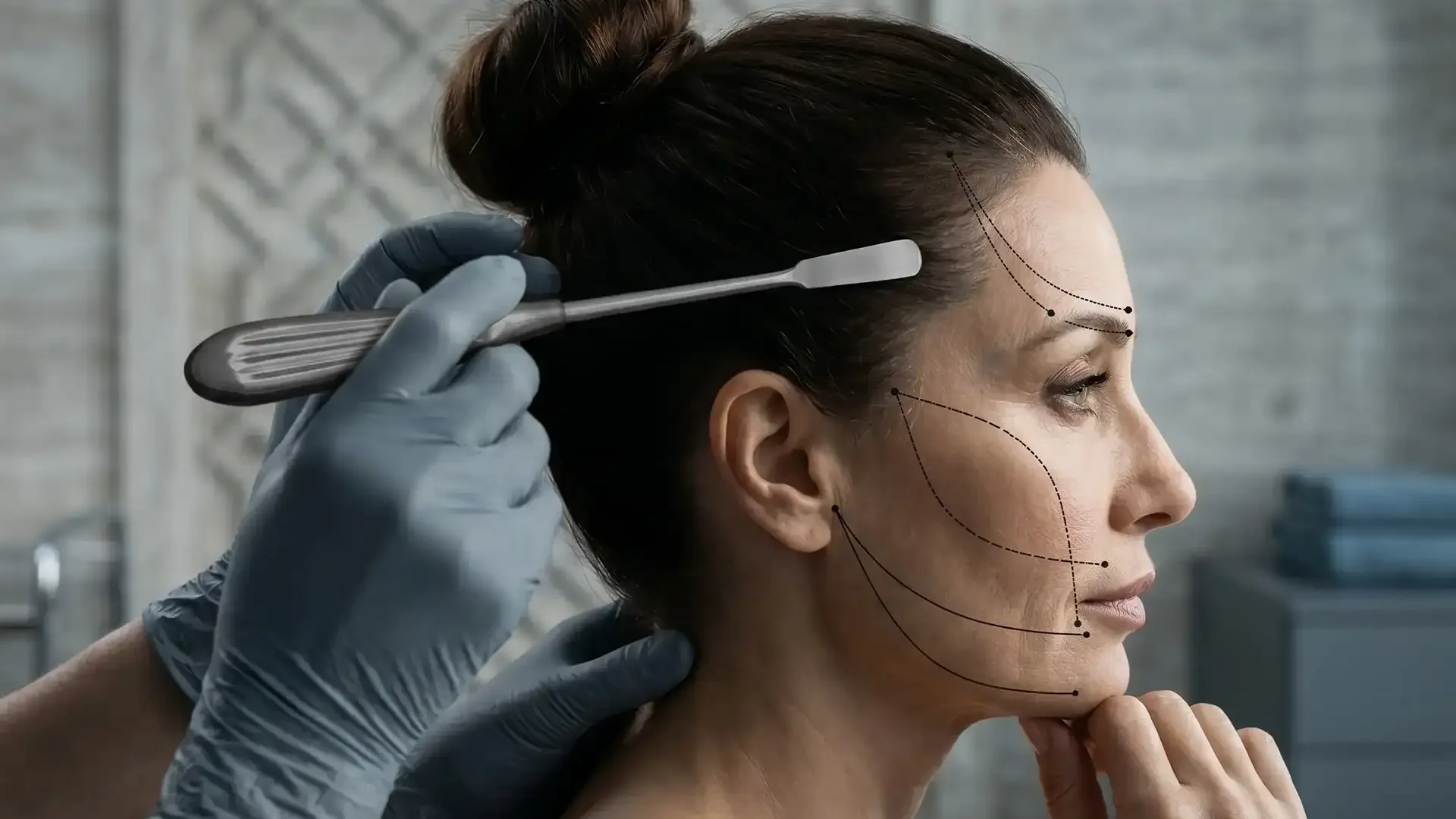
The visible stigmata of ageing—brow descent, forehead creases, and midface deflation—do not always require a full facelift incision to correct. Endoscopic facial lifting accesses the same anatomical planes as open surgery but through 3 to 5 small incisions hidden within the hairline and inside the mouth. A 4-millimetre endoscope transmits a magnified, illuminated view of the dissection plane to a high-definition monitor, giving the surgeon visualisation that in some respects surpasses what is possible with the naked eye.
Istanbul's facial plastic surgeons offer the endoscopic approach for appropriately selected patients, delivering results comparable to open techniques with a fraction of the scarring and a recovery measured in days rather than weeks. The cost advantage is substantial: 60 to 70 per cent below UK and European private rates.
Conditions This Treatment Addresses
Frequently Asked Questions
About Endoscopic Facial Lifting in Turkey
What is endoscopic facial lifting?
Endoscopic facial lifting is a minimally invasive technique that repositions descended brow and midface tissues through small, hidden incisions using a fibre-optic endoscope for magnified visualisation. It avoids the long coronal incision of traditional brow lifts, leaving no visible scars, and offers a faster recovery than open approaches.
How long does an endoscopic facelift last?
An endoscopic brow and midface lift typically lasts 7 to 10 years. The tissues are structurally repositioned using fixation devices that are gradually replaced by natural scar tissue, maintaining the lift. While the face continues to age, it does so from the elevated position rather than reverting to the preoperative state.
How much does an endoscopic facelift cost in Turkey?
An endoscopic brow and midface lift in Istanbul costs approximately £2,000–£3,500, compared to £6,000–£10,000 in the UK. The price includes surgery, anaesthesia, and all follow-up visits.
Will I have visible scars?
The incisions are placed within the hairline and inside the upper lip. Once healed, they are virtually invisible. This is the primary advantage of the endoscopic technique over open approaches, which require a longer incision that may be visible if hair is thin or receded.
Who is not a candidate for endoscopic lifting?
Patients with significant skin excess, very deep forehead creases that require skin excision, or advanced jowling and neck laxity are better served by open techniques. The endoscopic approach repositions tissue; it does not remove excess skin. A thorough consultation determines the appropriate technique.
How soon can I return to work after endoscopic lifting?
Most patients return to work and social activities within 10 to 14 days. By this point, swelling is approximately 80 per cent resolved and any residual bruising can be concealed with makeup. Strenuous exercise should be avoided for 3 weeks.
What Is Endoscopic Facial Lifting?
The endoscopic technique replaces the long coronal (ear-to-ear) incision of traditional brow and forehead lifts with 3 to 5 small incisions, each 1 to 2 centimetres long, placed within the hair-bearing scalp. Through these portals, the surgeon inserts the endoscope and specialised instruments to dissect the subperiosteal or subgaleal plane, releasing the arcus marginalis, lateral orbital adhesions, and zygomatic retaining ligaments.
Once the soft-tissue envelope is fully mobilised, it is repositioned superiorly and secured with absorbable fixation devices (Endotine endpoints or suture suspension to the bone). Because the skin is not excised, the lift redistributes rather than removes tissue, creating a natural elevation without tension. The midface component is accessed through a gingivobuccal sulcus incision inside the upper lip, leaving no external scar.
Who Is an Ideal Candidate?
Endoscopic lifting is ideal for patients aged 35 to 55 with early to moderate brow ptosis, forehead creasing, and midface descent who still have good skin elasticity. It is less suitable for patients with significant skin excess (where excision is required) or advanced jowling and neck laxity, which are better addressed by a deep plane facelift. The ideal candidate has realistic expectations: this is a repositioning procedure, not an excision.
Endoscopic Facelift Cost in Turkey vs. the UK and Europe
| Procedure | UK Cost | Turkey (Istanbul) Cost |
|---|---|---|
| Endoscopic Brow & Midface Lift | £6,000–£10,000 | £2,000–£3,500 |
| Endoscopic Brow Lift Only | £4,500–£7,000 | £1,500–£2,500 |
Prices include preoperative consultation, the surgical procedure, anaesthesia, and all post-operative follow-up during your stay in Istanbul. No overnight hospital stay is typically required.
The Procedure: What to Expect
Step 1: Anaesthesia and Incision Placement
Under general anaesthesia or deep sedation, 3 to 5 small incisions are made within the hairline. A gingivobuccal sulcus incision inside the upper lip provides access to the midface. No skin is excised externally.
Step 2: Endoscopic Dissection and Release
The endoscope is introduced through one port while dissection instruments work through others. The surgeon releases the periosteum and retaining ligaments under magnified vision, mobilising the forehead, brow, and midface as a continuous soft-tissue unit.
Step 3: Fixation and Closure
The elevated tissues are secured in their new, higher position using absorbable fixation tines (Endotine) or suture suspension to bone tunnels. The scalp incisions are closed with staples or sutures, and the intraoral incision with absorbable sutures. No drains are needed. A light head dressing is applied.
Meet Your Istanbul Surgeons
Vellum Select's endoscopic facial surgeons are board-certified and perform these procedures regularly, not occasionally. The endoscopic technique is equipment-dependent and surgeon-dependent: the quality of the endoscope, the surgeon's hand-eye coordination with the monitor, and their familiarity with the subperiosteal anatomy all directly affect the result. These surgeons have invested in both the technology and the training to deliver outcomes that match open techniques.
Journey to Recovery
Day 1: Surgery and Discharge
The endoscopic lift is performed under general anaesthesia or deep sedation and takes 2 to 3 hours. A light head dressing is applied. As this is typically a day-case procedure, you are discharged to your hotel the same day after a brief recovery period. Arrange for a companion to accompany you for the first 24 hours.
Day 1: Surgery and Discharge
The endoscopic lift is performed under general anaesthesia or deep sedation and takes 2 to 3 hours. A light head dressing is applied. As this is typically a day-case procedure, you are discharged to your hotel the same day after a brief recovery period. Arrange for a companion to accompany you for the first 24 hours.
Days 2 to 3: Early Recovery
Swelling is most pronounced on days 2 and 3, particularly around the eyes and midface. Cold compresses and head elevation (2–3 pillows) reduce swelling. Mild discomfort is managed with oral analgesia. The intraoral incision requires a soft, cool diet for 3 days. Most patients feel well enough for light activities in their hotel.
Days 2 to 3: Early Recovery
Swelling is most pronounced on days 2 and 3, particularly around the eyes and midface. Cold compresses and head elevation (2–3 pillows) reduce swelling. Mild discomfort is managed with oral analgesia. The intraoral incision requires a soft, cool diet for 3 days. Most patients feel well enough for light activities in their hotel.
Days 5 to 7: Suture Removal
Return to the clinic for removal of scalp staples or sutures. The intraoral sutures dissolve on their own. Most bruising has faded or can be concealed with makeup. You may wash your hair gently. By this point, many patients are exploring Istanbul comfortably.
Days 5 to 7: Suture Removal
Return to the clinic for removal of scalp staples or sutures. The intraoral sutures dissolve on their own. Most bruising has faded or can be concealed with makeup. You may wash your hair gently. By this point, many patients are exploring Istanbul comfortably.
Days 7 to 10: Cleared to Fly
Most international patients are cleared to fly home 7 to 10 days after surgery. Residual swelling is present but not conspicuous to others. The surgeon reviews healing and provides a long-term aftercare plan. Avoid strenuous activity and heavy lifting for 3 weeks.
Days 7 to 10: Cleared to Fly
Most international patients are cleared to fly home 7 to 10 days after surgery. Residual swelling is present but not conspicuous to others. The surgeon reviews healing and provides a long-term aftercare plan. Avoid strenuous activity and heavy lifting for 3 weeks.
Weeks 2 to 3: Social Recovery
By 2 weeks, approximately 80 per cent of swelling has resolved and the elevated brow and midface position is clearly visible. You can resume most social activities and return to work. Exercise may be gradually reintroduced after week 3.
Weeks 2 to 3: Social Recovery
By 2 weeks, approximately 80 per cent of swelling has resolved and the elevated brow and midface position is clearly visible. You can resume most social activities and return to work. Exercise may be gradually reintroduced after week 3.
Months 1 to 3: Final Settling
The Endotine fixation devices have fully absorbed and been replaced by natural fibrous tissue that maintains the lift. The brows, forehead, and midface have settled into their final position. Scars within the hairline are virtually invisible.
Months 1 to 3: Final Settling
The Endotine fixation devices have fully absorbed and been replaced by natural fibrous tissue that maintains the lift. The brows, forehead, and midface have settled into their final position. Scars within the hairline are virtually invisible.